In the two months since the U.S. economy was effectively shut down because of the COVID-19 Coronavirus pandemic it has brought into sharp focus the need for a basic understanding of economics. The country saw tough decisions around balancing competing interests, and nothing was more critical than the decision to stop the spread of the COVID-19 Coronavirus by shuttering many businesses and thereby costing numerous jobs. However, was shutting down the economy and society the right decision? Just how do we measure the value of each life saved through our social distancing actions? How do we compare that decision with the lives shattered by lost jobs, closed businesses, and destroyed retirement accounts?
As of the end of day April 18th there were approximately 39,000 estimated deaths from the virus and over 738,000 reported cases within the U.S. The table below shows just how these statistics compare with other recent pandemics and the seasonal flu.
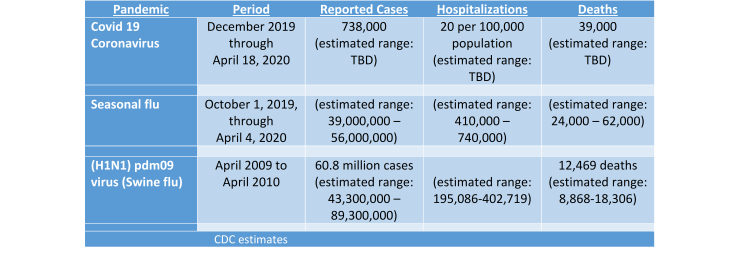
A July 2009 CDC report suggested that “hundreds of thousands of Americans could die over the next two years if the vaccine and other control measures for the H1N1 (Swine flu) influenza are not effective, and, at the pandemic’s peak, as much as 40% of the workforce could be affected,” according to new estimates from the Centers for Disease Control and Prevention. That was admittedly a worst-case scenario that the federal agency said it didn’t expect to occur. In the end the CDC’s final estimate was a death total of no more than 18,306, well short of the “hundreds of thousands” that they predicted.
In addition, each year an estimated 36,000 individuals die from the seasonal influenza virus. For this season – that runs from October 1, 2019 through the latest available data on April 4, 2020 – the CDC estimated that anywhere from 24,000 to 62,000 persons died, and somewhere between 410,000 and 740,000 were hospitalized owing to the seasonal influenza virus.
While it is true that the death rate (also called mortality rate) among those who contract the COVID-19 Coronavirus is significantly higher than those who are infected with the seasonal flu, or even those inflicted with the H1N1 (Swine flu) influenza, the total numbers of infected individuals is still relatively small compared with the overall population. Understandably many readers this will credit the smaller numbers of infections, hospitalizations and deaths resulting from the COVID-19 Coronavirus to the strict social distancing measures put in place. Others will say that the numbers in all three categories would have been much, much higher without these shut down measures. But did that still justify paralyzing our society and economy the way we have, and is the Cost-Benefit analysis worth it?
Many analysts have attempted to link the COVID-19 Coronavirus pandemic to the deadly ‘Spanish flu’ of 1918 which killed some 675,000 Americans and millions more across the globe. That pandemic was a similar strain to the H1N1 influenza that we saw in 2009 and 2010. So why did it kill so many in 1918, and less than 20,000 in 2010? Despite over 100 years of data and time to answer this question the answer is still not known with absolute certainty. What is known is that recent studies of available data from the time showed that the Spanish flu H1N1 influenza was no more aggressive than previous influenza strains. Instead, the researchers found that it was the aftermath of the disease and the response to it, like overcrowding in medical camps and hospitals, resulting in malnourishment and poor hygiene which promoted bacterial infection. This in turn killed most of the victims of the Spanish flu.
Since we will never really know what the true numbers of deaths would have been had these strict social distancing measures not been put in place the best we can do is conduct a hypothetical analysis. With better hospitals and bacterial control facilities there is no doubt that we would not experience the level of 675,000 deaths, even scaling up for population growth. So, let us assume that absent the wholesale shutting down of the economy the death levels would have been ten times higher than they are now, that means instead of 39,000 deaths it would have been closer to 390,000, let’s even round up to 400,000. Is that death level large enough to justify the stringent shut down measures?
In 2018 and 2019 there were over 2,800,000 reported deaths in America. That means in a worst-case scenario of nearly 400,000 Coronavirus-related deaths, that would still be less than 14% of all deaths last year. In a typical year over 600,000 Americans die separately from Cancer and heart disease as the table below depicts. Therefore, in a truly worst-case scenario total Coronavirus-related deaths would still be lower than those other categories.
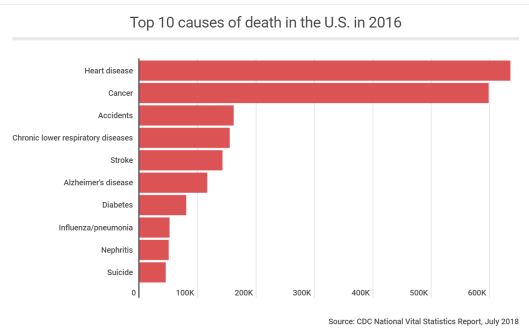
If we look at the evidence objectively we never shut down the economy and society because over 600,000 Americans died from heart disease, or from Cancer. Even after aggregating all those deaths we’ve seen that with over 2,800,000 combined deaths that was still not enough to shut down the economy. However, in an absolute worst-case scenario of 400,000 Coronavirus-related deaths we deemed it necessary to shut-down the economy without fully understanding the effects or consequences of that decision.
In the end, the social and economic costs associated with the extreme economic shut down are manifold, and include:
- Millions of business closings (many of them will be permanent closures).
- Tens of millions of job losses (more acute among the less skilled workforce which will push them into long-term poverty).
- Trillions of dollars of lost retirement savings which will negatively impact many retirees.
- Potentially hundreds of thousands impacted by mental health challenges (among them depression, anxiety and stress).
- Major disruption to the education of our children and their preparation for life (including diminished job prospects in the near term).
- A substantial jump in the National Debt in the order of Trillions of dollars which future generations will be asked to repay (with an increased likelihood that some of that Debt will never be repaid).
- Continued ‘easy-money’ brought on by the Federal Reserve’s loose monetary policy which will continue to foster ‘moral hazard’ type decisions (to be addressed another time).
- Decreased confidence in our public officials who we implicitly trust to make the best decisions for society given their access to critical information and resources.
- Finally, the opportunity cost of the higher National Debt levels (currently sitting at over Twenty Four Trillion dollars, If you prefer 24,400,000,000,000) which will cause us in ten, or twenty or thirty years to cut back on major social spending like health care which will then cost millions more lost lives in the future.
In effect by making the decision that we did we’re saying collectively that saving the extra lives that we did in 2020 (let’s say realistically that’s an extra 100,000 lives that were saved) is more important than the millions of lost businesses and economic livelihood; tens of millions of lost jobs; Trillions of dollars in lost retirement savings; hundreds of thousands of individuals impacted by mental health concerns in the months and years ahead; and just as importantly millions more Americans who will undoubtedly die in the future because of our weakened economic state brought about by higher levels of indebtedness. We’re even implicitly saying that those extra lives saved are more important than the 600,000 Cancer and heart disease lives that are lost each year since we never devoted anywhere need the same level of resources to saving those individuals as we did with trying to save these Coronavirus lives.
Every life is equally precious whether they died from the COVID-19 Coronavirus, or Heart disease, or Cancer, or something else. They’re also equally important whether they died in 2020, or 2030 or 2040. It is clearly understood that the reason for the economic and societal shutdown was because the CDC provided such dire estimates on the possible numbers of deaths. Unfortunately, the CDC has a clear history of stoking fear and paranoia among Americans by significantly overestimating the worst-case scenario of the number of deaths. We saw that with the Swine flu estimates in 2009 when they stated that “hundreds of thousands of Americans could die”. Therefore they should not be relied upon to decide critical economic activities within our society.
We entrust our civil servants and political leaders with the awesome responsibility of making the best decisions for our collective benefits. Those decisions should never be made to benefit only the few, nor taken with the best interests of just the few in mind but should be taken after weighing all of the costs and all of the benefits of all segments of society.
Instead of the wholesale closure of many non-essential businesses and schools in early March what then should our decision-makers have done? Consider the cases of Taiwan, South Korea, Germany and even Switzerland. Those countries conducted aggressive testing and isolated only the identified cases and the people with whom they came into contact. They also ensured that proper masks and other relevant equipment were widely available to the rest of society well before this outbreak became an international pandemic, something our decision-makers could also have prioritized. In addition, our decision-makers could have addressed one of the epicenters of the outbreak, namely nursing homes. Those facilities proved to be a breeding ground for the virus hence should have been identified early and isolated, along with everyone who is 65 years or older. Students – who’ve proven to be very resilient, with a very low mortality rate – should have been allowed to stay in schools, with proper allowance given to the elderly teachers and other school workers, and those children with pre-existing breathing conditions. If we can subsequently require all students to study from home then we should have been prepared to isolate only the vulnerable ones and then make adequate provisions for their learning at home. In any advanced society the needs of the many should never be subjugated because of our concern for the few. That’s not progress, instead it’s backward thinking.
Our society and economy should never have experienced the wholesale shut down that we saw in March. Nevertheless, it happened. Now it’s time for our politicians and policy-makers to do the sound economic thing and reopen the economy as soon as possible before the damage becomes too difficult to repair, both in terms of economic loss and society’s mental health.
Keith Thompson is a former Senior Economist with an agency within the U.S. Department of the Treasury, and a former adjunct Economics professor with Ramapo College of New Jersey. He currently works as an international tax professional for one of America’s largest corporations.
 KeithThompsonEconomist.com
Hi Keith, this is very informative and instrumentally put together. Unless articles like this are posted many of us remain in the dark and can’t see the bigger picture behind the scene where the government is concerned of managing money in this country. Thank you for the education sir, it’s well appreciated.
LikeLiked by 1 person
Dave, your comments are much appreciated. Unfortunately since this article was written we have seen in real time the full consequences of these questionable government decisions. Unemployment levels are at historic highs, business closures and bankruptcies are soaring and yet the Congress and Federal Reserve continue to pile Trillions in debt onto the shoulders of the next generation. Incompetence is running rampant throughout our government.
LikeLiked by 3 people
You are a true economic genius. When this article first came out I was on both sides as I could see where you were coming from but also why the government did what they did. Now I think that more and more people are coming over to your position that it was a mistake as the cost of fixing the economy now may be too high. They could have easily sheltered the elderly and sickly but allowed the rest of us to continue working. That way they wouldn’t have needed this massive bailout packages.
LikeLiked by 1 person
There is a lot of information here that is so extremely useful in order to make an educated stance on this peculiar time in our lives. I often come to the end of reading an article with the hopes of answering at least one questions, and bringing at least one question to light. One piece of information I am curious about, is the number of people that have lost their jobs vs. people who are working remotely, and even a number of people who have had to take up second jobs. The current household in the US sees two incomes, rather than previous generations, leaving many with lots of uncertainty, as you said.. This answers the question we all have, that only a true economist is able to fully educate us on: ‘So what does this mean for us? The article does a great job on showing us how so many crucial economic factors that affect everyday life we don’t normally take into consideration, such as something like a continued distrust of political leaders.
LikeLiked by 2 people
PJ thanks for your very insightful comment. It’s sad that the incidence of so many decisions by our political leaders tend to fall on the lower-middle class and less-fortunate members of society. The higher income, salaried workers tend to be able to work from home, whereas the less-fortunate ones tend to be more hourly wage and more likely to lose their jobs. Another consequence of poor decision-making.
LikeLiked by 1 person
Thanks for this very detailed and insightful article. I was unaware of some of the facts you presented. I am not an economist nor do I understand the nitty gritty of governments and politics, however I can understand pandemic and panic. You were very clear in the statistical implications of the prolonged quarantine, the associated deaths, and the past and proven long-term ramifications of extended shut-down. However, it is hard to ignore the current deaths due to a contagious virus than the future deaths due to economic disasters. People operate in the here and now, and fear what they can see – people currently dying for COV-19 and survivors with associated respiratory issues. The president and politicians from the respective parties need to do a much better job to communicate facts, solutions, and hope to the public. I understand the need for the country to reopen for business because $1200 stimulus cannot sustain a month’s worth of living expenses for the unemployed. However, with the lack of N95 masks readily available to the entire general public then actions to reopen the country seem premature to me. Hopefully this article makes it into the mainstream media so people with common sense and power will read, become knowledgeable, and do the right things.
LikeLiked by 1 person
Thanks for those thoughtful comments Nicola. It is true that society faces a tough choice between finding ways to curb the spread of the virus and spurring economic activity. As an advanced society we should be in a position to do both, not either or. Countries like Taiwan, South Korea and Germany are able to do that. Yes they’re smaller countries than we are but sound leadership will always win out every time, no matter the size of the country.
LikeLiked by 1 person
This was a very well written and insightful article. It gave a clear picture of the economic loss we all face during this pandemic and will possibly face for years to come. I have been employed as a consulting Psychologist in nursing homes for over 20 years. I was present for both the H1N1 influenza and now for Covid 19. We faced a lot of illness and death during both viruses, but the response from the government was not comparable. At first I felt exactly like the author feels. Why risk the state of our economy on what ifs and maybes. Now that I have faced the virus head on, I honestly can see why the government responded the way that it did. There are clear differences between the two viruses that make a more aggressive response necessary. The differences are seen mostly in the predictability of the viruses. With H1N1 we knew who was vulnerable and who would die. With the Covid 19 virus, we truly don’t know. Statistics will tell you that older adults and fragile populations will suffer more but this virus has also attacked the young and healthy as well. It is also unpredictable in that with H1N1 you knew who had it and you could avoid them. With this virus, you could be contagious with absolutely no symptoms and be infecting everyone around you. I also agree with the Author that we need to learn from this virus and make changes that prevent this from happening again during future pandemics. We also need to conform our society to assure for our continue economic growth and prosperity without the absolute need for constant travel and social contact in the event of a future pandemic. In a perfect world, where everything can be predicted with 100% accuracy, this Author is completely right but unfortunately life isn’t that predictable and this virus is even less predictable than life itself.
LikeLiked by 2 people
I appreciate your excellent comments Nancy and wholeheartedly agree that the complexity of this situation provides for some rather difficult decisions. Nevertheless as an economist I have the ability to ask and attempt to answer these very tough questions by looking at the effects of decisions in the short term as well as the long term. In the end these social distancing actions might save some lives now (maybe even hundreds of thousands) but if we weaken our economy significantly then we will have crippled our ability to provide even basic health care in the near future which will cause even more lives (possibly in the millions a few years from now). Remember we did see a similar strain of this virus before (called the Spanish flu) and while it was a bad one it wasn’t the virus that killed most people, it was the after effects that they experienced. Public officials should not promote fear and paranoia, but instead should calm society’s fears. These leaders could not do even that.
LikeLike
Very objective analysis filled with hard truths. Not for the uninformed. Unfortunately that’s how our so called political leaders would want it. Let such facts expressed in this article remain esoteric.
LikeLiked by 1 person
Great comments, thanks. Not everyone is an economist who can effectively parse through the social and economic costs and benefits of these actions. Nonetheless we trust that our political leaders have people on their staff who can adequately dive deeper into some of these complex issues.
In addition, just like during the great recession we’re once again seeing the Federal Reserve operating with reckless ‘easy money’ policy and there seems to be no one asking what the consequences of their action are.
LikeLike
Very objective analysis filled with hard truths. Not for the uninformed. Unfortunately, some of our so called political leaders would rather the populace are blind to it.
LikeLiked by 1 person
This is absolutely a solid article which provokes one to go deeper into the value of each life. This existential perspective pushes us to evaluate the decision made by a few that impact so many. Nevertheless, these are complicated times and these decisions are not easily made, the questions and facts presented in this article will undoubtedly drive you to come to your own conclusions.
LikeLiked by 2 people
I absolutely agree about the complexity of the situation and the fact is this was a very difficult decision across the board. Nevertheless listening to the media and our political leaders we saw very little dialogue around the costs and benefits of their decisions. Appreciate the comment.
LikeLike