
The monthly U.S. trade deficit rose to a nearly 10-year high in February 2018 to $57.6 billion. That was the highest level since October 2008 meaning that the trade deficit has now risen for six straight months. Of important political note the trade deficit with China fell some 18.6 percent to $29.3 billion while the deficit with Mexico surged over 46 percent.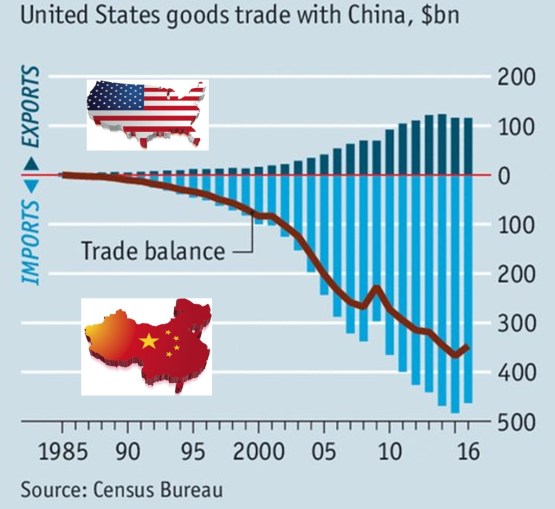
These monthly numbers underscore a more alarming trend, that the U.S. trade deficit in goods and services has been poor for a number of years, and has in fact worsened over the past few years. The trade deficit grew 12% last year to a mammoth $566 billion, its widest mark since 2008. According to the Commerce Department the goods deficit with China rose 8% to a record $375 billion in 2017. That is nearly half the total goods trade deficit (the U.S. interestingly operates a surplus on the service side of the trade ledger). In response to these disturbing trade trends President Trump recently targeted 25 percent tariffs on over 1,000 Chinese products. These tariffs are in addition to ones already imposed on imported solar panels, large washing machines, and import duties on steel (25 percent) and aluminum (10 percent).
Needless to say we would expect an immediate retaliation from China. In this case they did by imposing similar duties on key American exports to them, namely on soybeans, airplanes, cars, beef and chemicals. However, is this expected to be the totality of China’s response or can we expect changes in other areas of their operations.
The power of economic analysis is its ability to predict, or at the very least anticipate, likely behavior my economic agents in response to external stimuli (like a foreign power imposing trade restrictions on them). So what is China likely to do, and how could this impact the U.S. economy?
At $2.3 trillion China is the world’s largest exporter of tangible goods, representing over 17% of their entire economy. Like the Asian Tigers before them this export-led strategy has been the key to China’s economic development, and growth into a global superpower. No doubt China cannot afford to alienate their largest market here in the U.S. and so we can expect them to make some concessions to the Trump administration in order to protect those beneficial trade numbers. In that regard there is likely to be a short-term victory for President Trump as the Chinese deficit with the U.S. will decline.
Unfortunately, economics also teaches us about the ‘Law of Unintended Consequences’. This means that things that were not expected nor even desired are also likely to manifest themselves in response to certain economic decisions. Here the Trump administration’s trade policy could not only temporarily reduce the trade deficit with China, but also increase consumer prices and even more importantly from a national security standpoint accelerate China’s rise into economic and global prominence. This presidential directive will force China to now speed up the industrialization of their agrarian sector, thereby growing the size of their domestic market. Currently everyone of the large developed economies around the world grew by expanding their domestic markets. This led to new jobs being created, and increased consumer spending power which resulted in the growth of established industries, and the emergence of new ones. China has been slow to adopt this policy because of the sheer size of their population and the large subsistence sector therein. These new proposed tariffs could however accelerate China’s plans towards domestic market expansion.
When this policy shift occurs China will become less dependent on global trade, consequently less likely to be influenced by U.S. foreign policy. It will also make China a growing national security threat in the decades ahead. Its important to note that China already has significant leverage over U.S. policy-makers on economic matters. They own over $1.2 trillion worth of our federal debt. Should they desire they could do any number of things which could cripple or at least disrupt the U.S. economy. They could reduce their purchase of such debt, instead shifting their purchase to other regions of the globe, hence spreading their global influence. They could also sell some of their significant holdings of U.S. bonds. These strategies will drive up U.S. interest rates across the board. It could also lead to the U.S. not being able to fully fund their annual budget which it has been increasingly funding by using deficit financing. No area of the economy will be spared of those negative impacts.
China may not be ready to employ those ‘nuclear-style’ bond sale strategies, or significantly retaliate against the U.S. by increasing tariffs across the board for fear of how that could destabilize their own economy in the short term, however once they fully develop their domestic market then they may be more likely to challenge the U.S. hegemony across the globe. These tariff policies may win the battle over reducing the short-term trade deficit with China but they will almost certainly in the long-term cause the U.S. to lose out to China on global dominance as China uses the opportunity to develop internally.
Keith Thompson is a Senior Economist in Transfer Pricing with an agency within the U.S. Department of the Treasury, and an adjunct Economics professor with Ramapo College of New Jersey.
 KeithThompsonEconomist.com
Being that the US owes $1.2 trillion worth of debt to China sort of puts us in a tough position. As I see Trump’s initial intentions with increasing tariffs on goods exported from China, they do have a certain amount of power over us economically. By increasing tariffs, China will just adapt and find cheaper ways to get these same goods into their country. This could either be internally, or externally from another country. Obviously both countries depend on each other for goods significantly; but as I previously stated, the $1.2 trillion dollars worth of debt in a sense gives China the upper hand.
LikeLike
Very intetesting article. I read an article with similar content last week. I feel that China will take further measures then this first imposed tax. I feel trump did not even consider this as one of the options China had. I understand his reasoning for wanting to tax but at this time i do not feel he is making the right decision. He needs to look at the bigger picture seeing the last six months have not been on the up and up with him in concerns to our trase defecit. Good read with lots of information.
LikeLike
I do see and agree with how this is a small short term victory, but also could result in a larger long term defeat for the U.S. as a whole. As said before, China is going to follow the same path that countries around the globe have followed and use this time to grow internally. As they shift away from doing business and trade with the U.S. will only force them to do trade elsewhere or simply work with what they have. Relying more on themselves for sustainability will further strengthen them as a country because they will become more independent. On the other side, I do see why Trump raised these tariffs. From his standpoint he had to do something, and in this particular case the tariffs resulted in a win for now for the U.S. and himself.
LikeLike
This article was very interesting. One of the biggest and most worrying effects of Trump’s trade policies between China is the potential and predicted increase in goods for consumers. Most of the products imported from China are used by almost all Americans; the number of people being able to afford the products will obviously decrease if the price were to increase in the future.
LikeLike
Really good stuff! Thanks for sharing!
LikeLike
Excellent article. While it makes sense to try to reduce the overall deficit with China there is no question that it will lead to outcomes in the long run which Trump may not be fully concerning himself with. Hopefully someone in the govt is paying attention.
LikeLike