
• About
  • Home
  • Latest Posts

KeithThompsonEconomist.com

~ Addressing the many pressing economic problems facing this nation

KeithThompsonEconomist.com

Category Archives: Fiscal Deficit

Is the government’s financing of our economic recovery after the COVID-19 pandemic going to worsen our economic situation

25 Monday May 2020

Posted by Keith Thompson in Coronavirus response, Federal Spending, Fiscal Deficit, National Debt

≈ 4 Comments

Last month I wrote an article questioning the logic behind closing down the U.S. economy, and looking at the full social and economic costs associated with our social distancing policies. Needless to say, while there were strong opinions expressed on both sides of this debate, more people opposed my conclusions. They believed that the shutdown should have been pursued at all costs, whatever that means. As a result this article will attempt to quantify some of those costs, and present an alternative option that could possibly have achieved the best of all worlds. It does not attempt to re-litigate the issue of whether we should have made the wholesale decision to close down the economy. That decision is already made. The best we can do now is evaluate the consequence of that decision.

On May 15th the House of Representatives passed a $3 Trillion coronavirus relief bill intended to provide assistance to state and local governments, hazard pay to frontline health care workers, student debt forgiveness and bolster the Medicaid and Medicare health programs. The Senate, interestingly has not yet acted upon this House bill, preferring instead to propose its own new package. This $3 Trillion proposal is expected to be in addition to the $2.2 Trillion rescue and recovery package that the Congress already passed on March 26th to stimulate demand and promote economic growth, the third such measure to deal with the COVID-19 pandemic. Incidentally one month after that initial March 26th recovery package Congress approved another $484 billion coronavirus rescue package on April 23rd that was intended to deliver emergency aid to small businesses and hospitals because well two trillion dollars was just not sufficient. That means between the Executive and Legislative branches–that control fiscal policy–in just a month they had committed nearly $2.7 Trillion to clean up the mess caused by shuttering the economy, and are negotiating to spend another $3 Trillion. But exactly where does the government get all of this money to be spending like that? Do they have it stored up in a vault somewhere just saving for another emergency situation like this? Or are they relying on their good faith and credit to expand our already burgeoning National Debt beyond its already stratospheric $25,481,800,000,000 levels (read that twenty-five Trillion, four hundred eighty-one Billion, eight hundred million dollars) as of noon ET on Memorial Day. [It is important to note that this twenty-five plus Trillion dollar Debt figure significantly understates the true financial obligation of the Federal Government. When we add in the Government’s lifetime obligations to pay Medicare and Social Security benefits to its citizens, and military & civilian retirement commitments to its employees the Truth in Accounting nonprofit organization estimates that the Federal Government’s true financial obligation is closer to one hundred and seventeen Trillion dollars.]

Not to be outdone by our fiscal policy authorities, the ‘experts’ on the monetary policy side–the Federal Reserve–also contributed to the economic stimulus during the first week of April by purchasing over $2.3 Trillion of Bonds and other securities. They expanded their Balance Sheet by increasing the total assets base from $870 Billion in August 2007 (just before the great recession) to a whopping $6.37 Trillion in April 2020, and they did this just by writing a check to buy these assets, in effect ‘printing new money’. According to the Federal Reserve it will make an open-ended commitment to launch a barrage of programs that keeps buying assets under its quantitative easing measures. These include:
• a commitment to continue its asset purchasing program “in the amounts needed to support smooth market functioning and effective transmission of monetary policy to broader financial conditions and the economy.”
• purchase of agency commercial mortgage-backed securities as part of an expansion in its asset purchases. This represents an expansion into the commercial sector of real estate for the central bank’s acquisitions.
• purchasing the investment-grade corporate bond securities in primary and secondary markets and through exchange-traded funds.
• an unspecified lending program for Main Street businesses and the Term Asset-Backed Loan Facility implemented during the financial crisis.
• a program worth $300 billion “supporting the flow of credit” to employers, consumers and businesses and
• two facilities set up to provide credit to large employers.
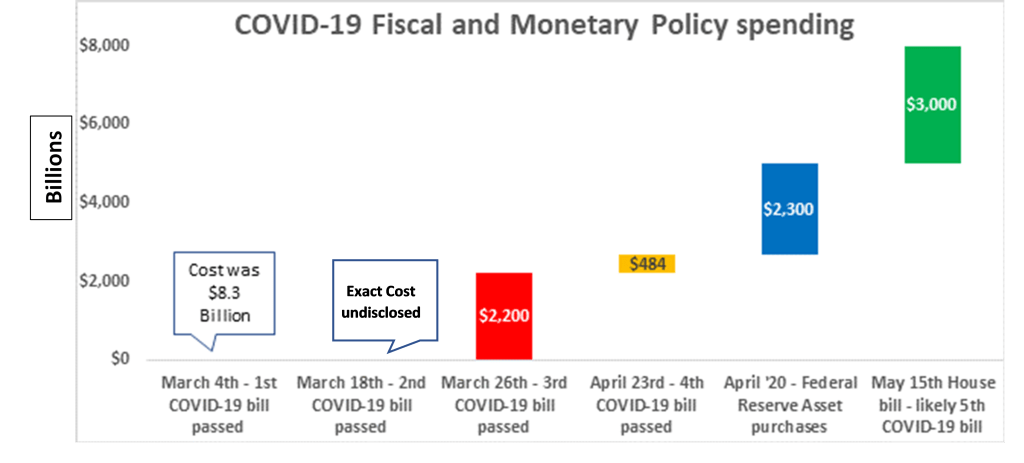
In just over one month America’s economic policy-makers (on both the fiscal and monetary sides) have borrowed over $5 Trillion to resuscitate the economy, hoping for a ‘bank-shot’ recovery with promises of more to come. Five Trillion dollars is a lot of money, and something that most of us cannot even fathom. Therefore to put that spending into context let’s compare it to the GDP of every country in the world. That level of spending represents the total value of all goods and services produced within the U.S. economy within any three-month period in 2018. It also represents the total value of all production within every country in 2019 except the United States, China and Japan. In the case of Japan five Trillion dollars would represent their total GDP for eleven and a half months in 2019. Adding an extra $3 Trillion to that number would make this round of spending the third largest economy in the world if it was its own country, such is the magnitude of these unprecedented spending levels. No matter how you look at it, it’s an incredibly large number indeed. But just how well are these programs expected to work, and how will they be repaid.

The Congress and the White House are relying on Keynesian-style fiscal policies similar to the ones used to stimulate the economies of America and Western Europe after World War 2. Those spending plans had a huge multiplier effect that stimulated their respective economies. That in turn caused private sector industries to thrive, thus reducing the role of the governments in the succeeding years. Owing to the relatively lower debt levels then in effect that policy was able to work. However, in 2020 with the U.S. already owing more than its total GDP there is very little opportunity for future stimulus should the next crisis occur within the next few years. The fact is that the country has a looming Medicare crisis with the hospital insurance trust fund expected to run out of money in 2026, and a pending Social Security one expected in 2034, therefore it is clear that this $5 Trillion infusion brings with it enormous Opportunity Costs as it will affect our ability to address those and future crises.

To underscore this let’s break down how debt-financing works. When someone spends out of their current income they have all of their future income available to spend in the succeeding years. However, when we use debt-financing we are spending out of future income. That means the five Trillion dollars that we spend today (in addition to the twenty-five plus Trillion dollars we owed before) will be coming from income expected to be earned in future years. Not only will we have to find additional funds to take care of Medicare and Social Security obligations, but we will also need to do it with less resources as we’ll have a larger debt load to repay.

Consider this, at the end of 2019–including interest on the Debt held by the public and Debt held by government accounts aka “intragovernmental debt”–the Federal Government paid approximately $570 Billion in interest payments, representing over 16 percent of all Tax receipts. That is about 1 in every 6 dollars received going out to pay interest on the Debt. This number is despite historically low interest rates in 2019 and 2020. However, in 10 to 20 years when these existing Debts mature and new ones have to be issued to replace them the Federal Government would have to pay significantly higher interest rates on much higher Debt levels. As a result the Congressional Budget Office estimated that Net Interest Payments will exceed $1 Trillion by 2030. This means that in the future for every $1 in tax revenues that the Federal government collects it will most likely have to divert between 20 and 25 percent just to pay the interest on that Debt, that is nearly 1 in every 4 dollars. The consequence of all this is that less than 80 or so cents on every dollar will be available for all other Federal government obligations and future commitments, unless of course the government continues to borrow more.

The issue with debt-financing is that it will have to be repaid at some time in the future. It therefore comes with a price. It borrows from the future to spend in the present. The expectation is that future generations will need to sacrificially repay those loans for the benefit of the present generation, and they will do so with fewer educational resources committed to them and reduced employment prospects available to them today.

As Senate Majority Leader McConnell and his Republican colleagues contemplate another round of Trillion dollar fiscal policy support to compete with the three Trillion dollar proposal from Speaker Pelosi and her House colleagues it is imperative that they carefully weigh the present-day benefits of any new spending plans against the long-term costs to future generations associated with the additional Debt burden. This is not free money. It will be incumbent upon our children and their children to repay it therefore give them a say in how much we should borrow, and how we should spend it.


Keith Thompson is a former Senior Economist with an agency within the U.S. Department of the Treasury, and a former adjunct Economics professor with Ramapo College of New Jersey. He currently works as an international tax professional for one of America’s largest corporations.
Economic analysis of America’s response to the Coronavirus pandemic

19 Sunday Apr 2020

Posted by Keith Thompson in Federal Spending, Fiscal Deficit, National Debt

≈ 14 Comments

In the two months since the U.S. economy was effectively shut down because of the COVID-19 Coronavirus pandemic it has brought into sharp focus the need for a basic understanding of economics. The country saw tough decisions around balancing competing interests, and nothing was more critical than the decision to stop the spread of the COVID-19 Coronavirus by shuttering many businesses and thereby costing numerous jobs. However, was shutting down the economy and society the right decision? Just how do we measure the value of each life saved through our social distancing actions? How do we compare that decision with the lives shattered by lost jobs, closed businesses, and destroyed retirement accounts?

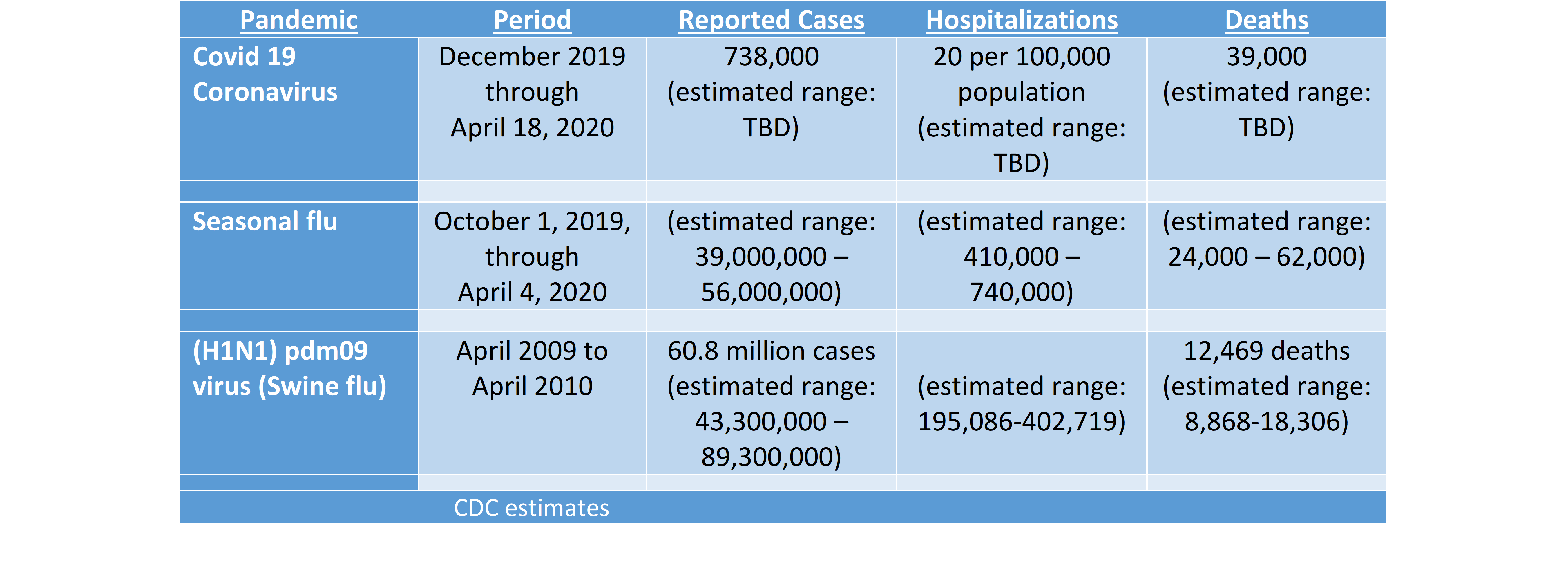
As of the end of day April 18th there were approximately 39,000 estimated deaths from the virus and over 738,000 reported cases within the U.S. The table below shows just how these statistics compare with other recent pandemics and the seasonal flu.

coronavirus1

A July 2009 CDC report suggested that “hundreds of thousands of Americans could die over the next two years if the vaccine and other control measures for the H1N1 (Swine flu) influenza are not effective, and, at the pandemic’s peak, as much as 40% of the workforce could be affected,” according to new estimates from the Centers for Disease Control and Prevention. That was admittedly a worst-case scenario that the federal agency said it didn’t expect to occur. In the end the CDC’s final estimate was a death total of no more than 18,306, well short of the “hundreds of thousands” that they predicted.

In addition, each year an estimated 36,000 individuals die from the seasonal influenza virus. For this season – that runs from October 1, 2019 through the latest available data on April 4, 2020 – the CDC estimated that anywhere from 24,000 to 62,000 persons died, and somewhere between 410,000 and 740,000 were hospitalized owing to the seasonal influenza virus.

While it is true that the death rate (also called mortality rate) among those who contract the COVID-19 Coronavirus is significantly higher than those who are infected with the seasonal flu, or even those inflicted with the H1N1 (Swine flu) influenza, the total numbers of infected individuals is still relatively small compared with the overall population. Understandably many readers this will credit the smaller numbers of infections, hospitalizations and deaths resulting from the COVID-19 Coronavirus to the strict social distancing measures put in place. Others will say that the numbers in all three categories would have been much, much higher without these shut down measures. But did that still justify paralyzing our society and economy the way we have, and is the Cost-Benefit analysis worth it?

Many analysts have attempted to link the COVID-19 Coronavirus pandemic to the deadly ‘Spanish flu’ of 1918 which killed some 675,000 Americans and millions more across the globe. That pandemic was a similar strain to the H1N1 influenza that we saw in 2009 and 2010. So why did it kill so many in 1918, and less than 20,000 in 2010? Despite over 100 years of data and time to answer this question the answer is still not known with absolute certainty. What is known is that recent studies of available data from the time showed that the Spanish flu H1N1 influenza was no more aggressive than previous influenza strains. Instead, the researchers found that it was the aftermath of the disease and the response to it, like overcrowding in medical camps and hospitals, resulting in malnourishment and poor hygiene which promoted bacterial infection. This in turn killed most of the victims of the Spanish flu.

Since we will never really know what the true numbers of deaths would have been had these strict social distancing measures not been put in place the best we can do is conduct a hypothetical analysis. With better hospitals and bacterial control facilities there is no doubt that we would not experience the level of 675,000 deaths, even scaling up for population growth. So, let us assume that absent the wholesale shutting down of the economy the death levels would have been ten times higher than they are now, that means instead of 39,000 deaths it would have been closer to 390,000, let’s even round up to 400,000. Is that death level large enough to justify the stringent shut down measures?

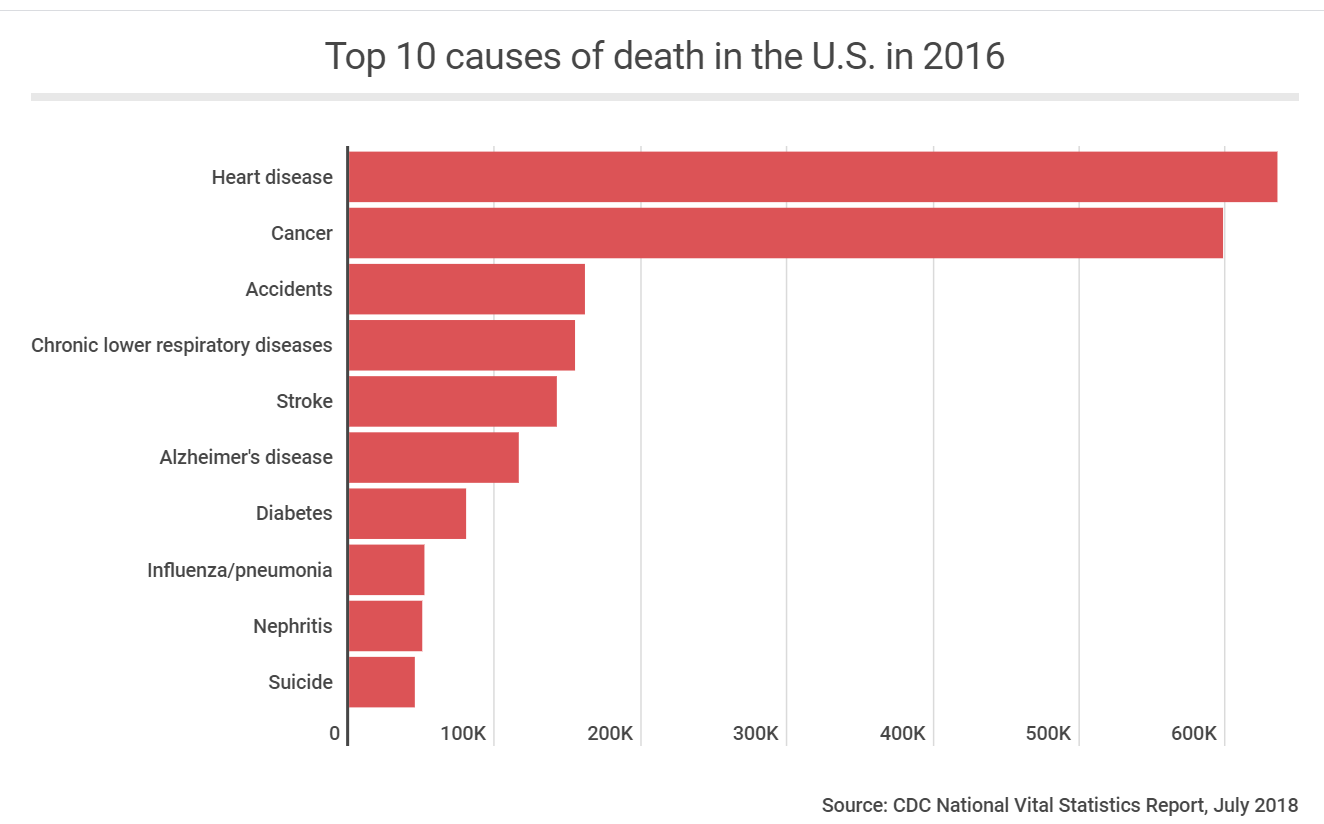
In 2018 and 2019 there were over 2,800,000 reported deaths in America. That means in a worst-case scenario of nearly 400,000 Coronavirus-related deaths, that would still be less than 14% of all deaths last year. In a typical year over 600,000 Americans die separately from Cancer and heart disease as the table below depicts. Therefore, in a truly worst-case scenario total Coronavirus-related deaths would still be lower than those other categories.

coronavirus2

If we look at the evidence objectively we never shut down the economy and society because over 600,000 Americans died from heart disease, or from Cancer. Even after aggregating all those deaths we’ve seen that with over 2,800,000 combined deaths that was still not enough to shut down the economy. However, in an absolute worst-case scenario of 400,000 Coronavirus-related deaths we deemed it necessary to shut-down the economy without fully understanding the effects or consequences of that decision.

In the end, the social and economic costs associated with the extreme economic shut down are manifold, and include:

  • Millions of business closings (many of them will be permanent closures).
  • Tens of millions of job losses (more acute among the less skilled workforce which will push them into long-term poverty).
  • Trillions of dollars of lost retirement savings which will negatively impact many retirees.
  • Potentially hundreds of thousands impacted by mental health challenges (among them depression, anxiety and stress).
  • Major disruption to the education of our children and their preparation for life (including diminished job prospects in the near term).
  • A substantial jump in the National Debt in the order of Trillions of dollars which future generations will be asked to repay (with an increased likelihood that some of that Debt will never be repaid).
  • Continued ‘easy-money’ brought on by the Federal Reserve’s loose monetary policy which will continue to foster ‘moral hazard’ type decisions (to be addressed another time).
  • Decreased confidence in our public officials who we implicitly trust to make the best decisions for society given their access to critical information and resources.
  • Finally, the opportunity cost of the higher National Debt levels (currently sitting at over Twenty Four Trillion dollars, If you prefer 24,400,000,000,000) which will cause us in ten, or twenty or thirty years to cut back on major social spending like health care which will then cost millions more lost lives in the future.

In effect by making the decision that we did we’re saying collectively that saving the extra lives that we did in 2020 (let’s say realistically that’s an extra 100,000 lives that were saved) is more important than the millions of lost businesses and economic livelihood; tens of millions of lost jobs; Trillions of dollars in lost retirement savings; hundreds of thousands of individuals impacted by mental health concerns in the months and years ahead; and just as importantly millions more Americans who will undoubtedly die in the future because of our weakened economic state brought about by higher levels of indebtedness. We’re even implicitly saying that those extra lives saved are more important than the 600,000 Cancer and heart disease lives that are lost each year since we never devoted anywhere need the same level of resources to saving those individuals as we did with trying to save these Coronavirus lives.

Every life is equally precious whether they died from the COVID-19 Coronavirus, or Heart disease, or Cancer, or something else. They’re also equally important whether they died in 2020, or 2030 or 2040. It is clearly understood that the reason for the economic and societal shutdown was because the CDC provided such dire estimates on the possible numbers of deaths. Unfortunately, the CDC has a clear history of stoking fear and paranoia among Americans by significantly overestimating the worst-case scenario of the number of deaths. We saw that with the Swine flu estimates in 2009 when they stated that “hundreds of thousands of Americans could die”. Therefore they should not be relied upon to decide critical economic activities within our society.

We entrust our civil servants and political leaders with the awesome responsibility of making the best decisions for our collective benefits. Those decisions should never be made to benefit only the few, nor taken with the best interests of just the few in mind but should be taken after weighing all of the costs and all of the benefits of all segments of society.

Instead of the wholesale closure of many non-essential businesses and schools in early March what then should our decision-makers have done? Consider the cases of Taiwan, South Korea, Germany and even Switzerland. Those countries conducted aggressive testing and isolated only the identified cases and the people with whom they came into contact. They also ensured that proper masks and other relevant equipment were widely available to the rest of society well before this outbreak became an international pandemic, something our decision-makers could also have prioritized. In addition, our decision-makers could have addressed one of the epicenters of the outbreak, namely nursing homes. Those facilities proved to be a breeding ground for the virus hence should have been identified early and isolated, along with everyone who is 65 years or older. Students – who’ve proven to be very resilient, with a very low mortality rate – should have been allowed to stay in schools, with proper allowance given to the elderly teachers and other school workers, and those children with pre-existing breathing conditions. If we can subsequently require all students to study from home then we should have been prepared to isolate only the vulnerable ones and then make adequate provisions for their learning at home. In any advanced society the needs of the many should never be subjugated because of our concern for the few. That’s not progress, instead it’s backward thinking.

Our society and economy should never have experienced the wholesale shut down that we saw in March. Nevertheless, it happened. Now it’s time for our politicians and policy-makers to do the sound economic thing and reopen the economy as soon as possible before the damage becomes too difficult to repair, both in terms of economic loss and society’s mental health.


Keith Thompson is a former Senior Economist with an agency within the U.S. Department of the Treasury, and a former adjunct Economics professor with Ramapo College of New Jersey. He currently works as an international tax professional for one of America’s largest corporations.
America’s Youth: The Real Losers in 2016

31 Saturday Dec 2016

Posted by Keith Thompson in Federal Spending, Fiscal Deficit, National Debt

≈ 3 Comments

As we close out the year 2016 it is an opportune time to reflect on the state of the American Union and the pathway forward for sustained growth. After one of the most contentious presidential elections in modern political history America is once again juxtaposed in that delicate nexus between hope and disillusionment. Hope resonates amongst the supporters of President-elect Trump who see optimism in the country’s future, whereas despair looms large over the supporters of Hillary Rodham Clinton who worry about an America very different from the one they envision. Yet all Americans, Democrats and Republicans alike, should show some measure of concern for our youth who were largely left out of the electioneering discourse about the country’s future.

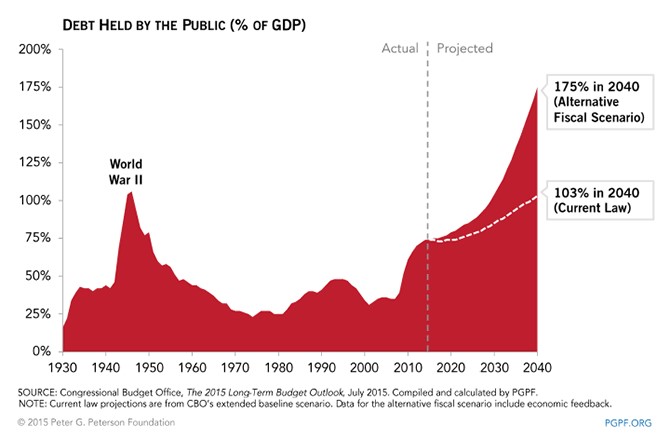
2015_cbo_longterm_chart1v2Let’s consider that the country’s largest economic constraints – the overburdened National Debt, soaring Social Security costs, and out-of-control Medicare obligations – represent the Federal government’s largest fiscal outlays. We are at a period in our history where Debt to GDP (including intra-agency Debt) is now over 100%, Social Security expenditures are running at nearly $900 Billion last year (23% of the Budget), and net Medicare/Medicaid obligations are currently at over $580 Billion in 2016 (15% of the Budget). What’s more troubling, however, is the trend in these numbers. The Peterson Foundation, with data from the non-partisan Congressional Budget Office (CBO), estimates that under existing law each will grow exponentially over the next 20+ years. Yet despite that impending fiscal crisis precious little was discussed about either long-term obligation on the campaign trails. Who does America think will be left to clean up the financial mess from these out-of-control spending, our youth. That would be the many of us currently in middle age, our young children and our (eventual) grand-children.
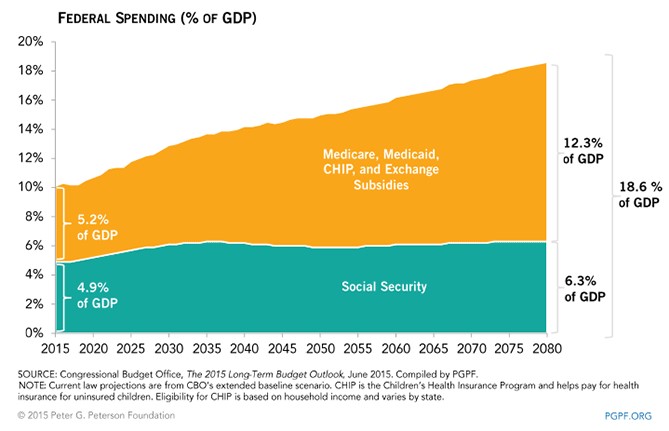
2015_cbo_longterm_chart5v2

Now that the semester is over I have time to reflect on the happenings in my College economics classes. At the end of a recent class a student came up to me to discuss the state of the economy. “Why” he asked “does our government make decisions where the costs of those decisions do not fall on the same group of people who receive the benefits.” That was a hard one to answer, I responded. After all politicians seem to be incentivized to make decisions with short-term benefits (so that they can effectively stay in power) hence it is rational for them to implement policies that benefit population groups with the highest voting rates (and that coincidentally does not belong to Millennials who had just a 50% voter turnout in the recent election). Conversely, tough decisions that have primarily long-term benefits tend to be postponed (or in Washington speak they “kick the can down the road”). That is the current state of our National Debt, Social Security, and Medicare obligations. The consequence of these decisions is that the living standards and income of our youth will significantly decline in the years ahead as the Peterson Foundation chart below shows.

2015_cbo_longterm_chart2v2

It is time that our politicians start actively thinking about the next generation when they craft policies. America can’t keep spending just to please the current generation of retirees with little regard for the well-being of our youth. After all it is America’s youth who will have to pay for these obligations in the years to come in the form of higher taxes, reduced benefits & services and lower real incomes.

President-elect Trump’s new administration and Congress need to put a plan in place to deal with these impending calamities, specifically:

  • Limit the Debt to GDP ratio to no more than 100%, with a plan to pay it down annually.
  • Limit the Overall Spending to GDP ratio to no more than 20%.
  • Limit the Budget Deficit to GDP ratio to no more than 1%.
  • Finally, both groups need to institute a super-majority requirement in both houses of Congress that must be met before these ratios can be breached (and only in cases of National emergencies).

The longer-term policy goal should be to get America’s fiscal house in order by generating Budget Surpluses and using them to pay down the Debt. If we don’t act now our youth will inherit an economy that looks a lot closer to a Third World economy, than the Advanced Industrial power that it truly is.


Keith Thompson is a Senior Economist in Transfer Pricing with an agency within the U.S. Department of the Treasury, and an adjunct Economics professor with Ramapo College of New Jersey.

When will our politicians deal with the Big Red Elephant in the room (our out-of-control National Debt)

27 Saturday Feb 2016

Posted by Keith Thompson in Federal Spending, Fiscal Deficit, National Debt

≈ 2 Comments

As the 2016 presidential election moves into top gear each party is vying to win over their respective constituents with promises and grand overtures ranging from eliminating student loan payments to expanding our already burgeoning military spending. The problem with these out-of-control promises and misaligned fiscal priorities is that the government is spending ever more than it collects in tax revenues resulting in a large and growing deficit. In FY2014 for e.g., the federal government spent over $3.5 Trillion while collecting only $3.0 Trillion in revenues. The net result is a $500 Billion deficit, causing the National Debt to balloon upwards.

With fully two-thirds of the nation’s federal spending tied to mandatory items in the budget such as Social Security, Medicare & Medicaid, and Interest payments on the Debt there is hardly any wriggle room to continue adding to the nation’s spending priorities. And yet the Republican presidential candidates are continuing to spew out useless rhetoric that they will expand military spending well beyond the 17% of total spending that it currently occupies, while cutting taxes even further. The consequence of these inconceivable decisions is to expand the debt even further to a point where future generations will be trapped and unable to do anything else but repay it. Likewise, not to be outdone, their Democratic presidential counterparts are competing to see who can propose the most fiscally irresponsible list of social spending programs by stumping for free college, eliminating student loans, and expanding every welfare program known to mankind. Where will it end? Social Security and Healthcare spending such as Medicare & Medicaid already account for nearly a half of all federal spending (almost 10% of GDP) with the cohort of recipients growing faster than the general population. This means that future obligations will also grow at a fast clip. Yet as ominous as these facts are none of the presidential candidates are seriously addressing the challenges with a plan for dealing with these impending crises. Instead they selfishly preach to their converts the virtues of maintaining the status quo.

What does this mean for the future of America, one in which we’re either experiencing runaway military spending – albeit in a lower-tax environment – or enjoying ever expanded social welfare expenditures. It means that as a nation we can only afford that by adding to the already burdensome $19 Trillion National Debt, and that leads to two undesirable consequences. One is that the debt continues to incur ever exorbitant interest charges which have to be funded out of the current budget, and the other is that the debt has to be repaid at some point in the future (it cannot be deferred indefinitely). In FY2014 the federal government paid about $230 Billion in interest expenses (totaling nearly 7% of the budget) however this is somewhat misleading since that number does not count the Billions paid to other government agencies that also hold the national debt. Including those holdings reveals that we’re really paying over $430 Billion in interest expenses each year. That’s a staggering 12% of the total budget (nearly 3% of GDP) that’s not producing any current benefits to society, simply paying for the privilege of enjoying past expenditures. The added problem is that this number will only keep growing if we as a nation do not take a stand to reprioritize our spending. According to analysis from both the GAO and the Treasury Department interest payments on the National Debt will be the single largest category of spending within the next 50 years if we don’t change the current trajectory. Similarly, our debt-to-GDP ratio will reach unprecedented levels of over 300%, unheard of for a developed, industrialized economy.

The youth in America need to demand an open dialogue and discussion with those individuals currently running for the highest office in the land. If current trends continue these youths will not be able to enjoy any benefits from Social Security in 30 to 50 years’ time; and Medicare will not exist in any meaningful form for their parents to utilize, putting additional burden on them to look after their parents in the future, let alone themselves when the time eventually comes. Adding to that dilemma will be the fact that this younger generation will be asked to live with much higher tax rates to pay for servicing this mammoth debt which they had no part in its accumulation, and for which they enjoyed no benefits since all of the gains from it went to past and current generations of seniors and to war hawks. One of the most basic principles of economics is that of Costs and Benefits. Benefits and Costs should accompany the same economic units. Instead our runaway debt crisis will see the benefits accrue to the current and past generations of seniors and politicians among us, while their children and grandchildren will be left holding the bag and paying the price.

As at September 30, 2014 the Treasury Department in its Citizen’s Guide report illustrated that the Federal Government had assets of $3.0 Trillion but liabilities (including the national debt) of $20.8 Trillion. That means that the government is effectively broke. Instead of our presidential candidates debating ways to increase the deficit and ultimately the debt how about discussing ways to curtail the deficit, and eventually pay down the debt. Maybe we can start by restricting the budget to no more than 20% of GDP and the debt to no more than 100% of GDP. Next, we should consider capping benefits to today’s current seniors instead of promising them the moon, knowing full well that as a nation we just can’t afford it.


Keith Thompson is a Senior Economist in Transfer Pricing with an agency within the US Department of the Treasury, and an adjunct Economics professor with Ramapo College of New Jersey.

Subscribe

  • Entries (RSS)
  • Comments (RSS)

Archives

  • May 2020
  • April 2020
  • April 2018
  • December 2016
  • September 2016
  • July 2016
  • April 2016
  • March 2016
  • February 2016

Categories

  • Black Economics
  • Black Lives
  • Blacks in America
  • Coronavirus response
  • Federal Spending
  • Fiscal Deficit
  • International Trade
  • National Debt
  • Tax Reform
  • Uncategorized

Meta

  • Create account
  • Log in

Create a free website or blog at WordPress.com.

Privacy & Cookies: This site uses cookies. By continuing to use this website, you agree to their use.
To find out more, including how to control cookies, see here: Cookie Policy
  • Subscribe Subscribed
    • KeithThompsonEconomist.com
    • Already have a WordPress.com account? Log in now.
    • KeithThompsonEconomist.com
    • Subscribe Subscribed
    • Sign up
    • Log in
    • Report this content
    • View site in Reader
    • Manage subscriptions
    • Collapse this bar
 

Loading Comments...