• About
  • Home
  • Latest Posts

KeithThompsonEconomist.com

~ Addressing the many pressing economic problems facing this nation

KeithThompsonEconomist.com

Author Archives: Keith Thompson

Is the government’s financing of our economic recovery after the COVID-19 pandemic going to worsen our economic situation

25 Monday May 2020

Posted by Keith Thompson in Coronavirus response, Federal Spending, Fiscal Deficit, National Debt

≈ 4 Comments

Last month I wrote an article questioning the logic behind closing down the U.S. economy, and looking at the full social and economic costs associated with our social distancing policies. Needless to say, while there were strong opinions expressed on both sides of this debate, more people opposed my conclusions. They believed that the shutdown should have been pursued at all costs, whatever that means. As a result this article will attempt to quantify some of those costs, and present an alternative option that could possibly have achieved the best of all worlds. It does not attempt to re-litigate the issue of whether we should have made the wholesale decision to close down the economy. That decision is already made. The best we can do now is evaluate the consequence of that decision.

On May 15th the House of Representatives passed a $3 Trillion coronavirus relief bill intended to provide assistance to state and local governments, hazard pay to frontline health care workers, student debt forgiveness and bolster the Medicaid and Medicare health programs. The Senate, interestingly has not yet acted upon this House bill, preferring instead to propose its own new package. This $3 Trillion proposal is expected to be in addition to the $2.2 Trillion rescue and recovery package that the Congress already passed on March 26th to stimulate demand and promote economic growth, the third such measure to deal with the COVID-19 pandemic. Incidentally one month after that initial March 26th recovery package Congress approved another $484 billion coronavirus rescue package on April 23rd that was intended to deliver emergency aid to small businesses and hospitals because well two trillion dollars was just not sufficient. That means between the Executive and Legislative branches–that control fiscal policy–in just a month they had committed nearly $2.7 Trillion to clean up the mess caused by shuttering the economy, and are negotiating to spend another $3 Trillion. But exactly where does the government get all of this money to be spending like that? Do they have it stored up in a vault somewhere just saving for another emergency situation like this? Or are they relying on their good faith and credit to expand our already burgeoning National Debt beyond its already stratospheric $25,481,800,000,000 levels (read that twenty-five Trillion, four hundred eighty-one Billion, eight hundred million dollars) as of noon ET on Memorial Day. [It is important to note that this twenty-five plus Trillion dollar Debt figure significantly understates the true financial obligation of the Federal Government. When we add in the Government’s lifetime obligations to pay Medicare and Social Security benefits to its citizens, and military & civilian retirement commitments to its employees the Truth in Accounting nonprofit organization estimates that the Federal Government’s true financial obligation is closer to one hundred and seventeen Trillion dollars.]

Not to be outdone by our fiscal policy authorities, the ‘experts’ on the monetary policy side–the Federal Reserve–also contributed to the economic stimulus during the first week of April by purchasing over $2.3 Trillion of Bonds and other securities. They expanded their Balance Sheet by increasing the total assets base from $870 Billion in August 2007 (just before the great recession) to a whopping $6.37 Trillion in April 2020, and they did this just by writing a check to buy these assets, in effect ‘printing new money’. According to the Federal Reserve it will make an open-ended commitment to launch a barrage of programs that keeps buying assets under its quantitative easing measures. These include:
• a commitment to continue its asset purchasing program “in the amounts needed to support smooth market functioning and effective transmission of monetary policy to broader financial conditions and the economy.”
• purchase of agency commercial mortgage-backed securities as part of an expansion in its asset purchases. This represents an expansion into the commercial sector of real estate for the central bank’s acquisitions.
• purchasing the investment-grade corporate bond securities in primary and secondary markets and through exchange-traded funds.
• an unspecified lending program for Main Street businesses and the Term Asset-Backed Loan Facility implemented during the financial crisis.
• a program worth $300 billion “supporting the flow of credit” to employers, consumers and businesses and
• two facilities set up to provide credit to large employers.
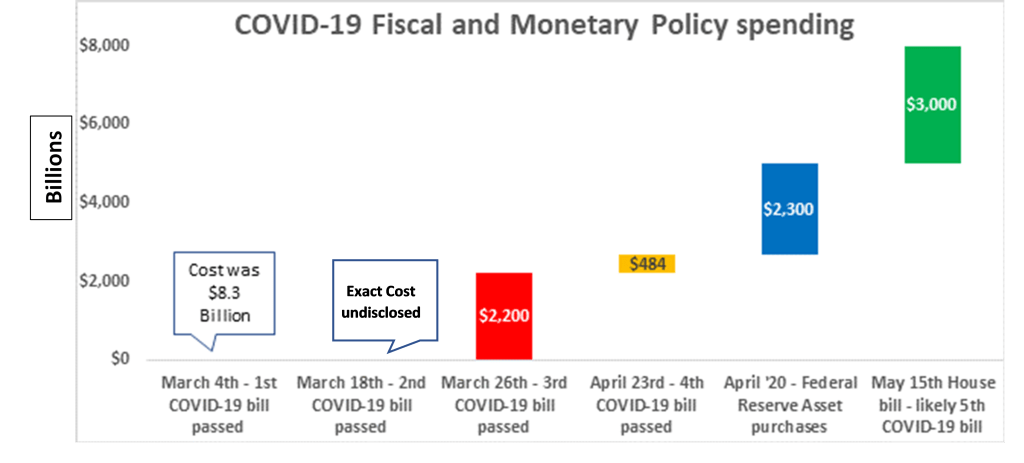
In just over one month America’s economic policy-makers (on both the fiscal and monetary sides) have borrowed over $5 Trillion to resuscitate the economy, hoping for a ‘bank-shot’ recovery with promises of more to come. Five Trillion dollars is a lot of money, and something that most of us cannot even fathom. Therefore to put that spending into context let’s compare it to the GDP of every country in the world. That level of spending represents the total value of all goods and services produced within the U.S. economy within any three-month period in 2018. It also represents the total value of all production within every country in 2019 except the United States, China and Japan. In the case of Japan five Trillion dollars would represent their total GDP for eleven and a half months in 2019. Adding an extra $3 Trillion to that number would make this round of spending the third largest economy in the world if it was its own country, such is the magnitude of these unprecedented spending levels. No matter how you look at it, it’s an incredibly large number indeed. But just how well are these programs expected to work, and how will they be repaid.

The Congress and the White House are relying on Keynesian-style fiscal policies similar to the ones used to stimulate the economies of America and Western Europe after World War 2. Those spending plans had a huge multiplier effect that stimulated their respective economies. That in turn caused private sector industries to thrive, thus reducing the role of the governments in the succeeding years. Owing to the relatively lower debt levels then in effect that policy was able to work. However, in 2020 with the U.S. already owing more than its total GDP there is very little opportunity for future stimulus should the next crisis occur within the next few years. The fact is that the country has a looming Medicare crisis with the hospital insurance trust fund expected to run out of money in 2026, and a pending Social Security one expected in 2034, therefore it is clear that this $5 Trillion infusion brings with it enormous Opportunity Costs as it will affect our ability to address those and future crises.

To underscore this let’s break down how debt-financing works. When someone spends out of their current income they have all of their future income available to spend in the succeeding years. However, when we use debt-financing we are spending out of future income. That means the five Trillion dollars that we spend today (in addition to the twenty-five plus Trillion dollars we owed before) will be coming from income expected to be earned in future years. Not only will we have to find additional funds to take care of Medicare and Social Security obligations, but we will also need to do it with less resources as we’ll have a larger debt load to repay.

Consider this, at the end of 2019–including interest on the Debt held by the public and Debt held by government accounts aka “intragovernmental debt”–the Federal Government paid approximately $570 Billion in interest payments, representing over 16 percent of all Tax receipts. That is about 1 in every 6 dollars received going out to pay interest on the Debt. This number is despite historically low interest rates in 2019 and 2020. However, in 10 to 20 years when these existing Debts mature and new ones have to be issued to replace them the Federal Government would have to pay significantly higher interest rates on much higher Debt levels. As a result the Congressional Budget Office estimated that Net Interest Payments will exceed $1 Trillion by 2030. This means that in the future for every $1 in tax revenues that the Federal government collects it will most likely have to divert between 20 and 25 percent just to pay the interest on that Debt, that is nearly 1 in every 4 dollars. The consequence of all this is that less than 80 or so cents on every dollar will be available for all other Federal government obligations and future commitments, unless of course the government continues to borrow more.

The issue with debt-financing is that it will have to be repaid at some time in the future. It therefore comes with a price. It borrows from the future to spend in the present. The expectation is that future generations will need to sacrificially repay those loans for the benefit of the present generation, and they will do so with fewer educational resources committed to them and reduced employment prospects available to them today.

As Senate Majority Leader McConnell and his Republican colleagues contemplate another round of Trillion dollar fiscal policy support to compete with the three Trillion dollar proposal from Speaker Pelosi and her House colleagues it is imperative that they carefully weigh the present-day benefits of any new spending plans against the long-term costs to future generations associated with the additional Debt burden. This is not free money. It will be incumbent upon our children and their children to repay it therefore give them a say in how much we should borrow, and how we should spend it.


Keith Thompson is a former Senior Economist with an agency within the U.S. Department of the Treasury, and a former adjunct Economics professor with Ramapo College of New Jersey. He currently works as an international tax professional for one of America’s largest corporations.
Economic analysis of America’s response to the Coronavirus pandemic

19 Sunday Apr 2020

Posted by Keith Thompson in Federal Spending, Fiscal Deficit, National Debt

≈ 14 Comments

In the two months since the U.S. economy was effectively shut down because of the COVID-19 Coronavirus pandemic it has brought into sharp focus the need for a basic understanding of economics. The country saw tough decisions around balancing competing interests, and nothing was more critical than the decision to stop the spread of the COVID-19 Coronavirus by shuttering many businesses and thereby costing numerous jobs. However, was shutting down the economy and society the right decision? Just how do we measure the value of each life saved through our social distancing actions? How do we compare that decision with the lives shattered by lost jobs, closed businesses, and destroyed retirement accounts?

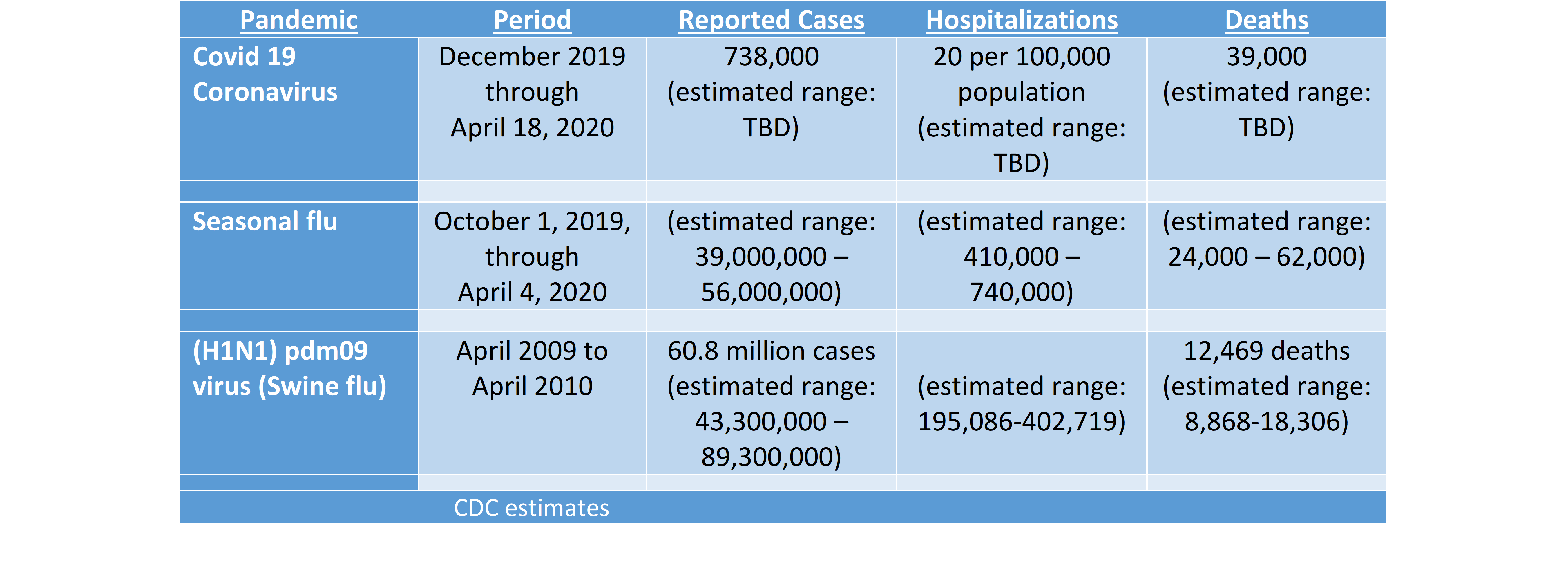
As of the end of day April 18th there were approximately 39,000 estimated deaths from the virus and over 738,000 reported cases within the U.S. The table below shows just how these statistics compare with other recent pandemics and the seasonal flu.

coronavirus1

A July 2009 CDC report suggested that “hundreds of thousands of Americans could die over the next two years if the vaccine and other control measures for the H1N1 (Swine flu) influenza are not effective, and, at the pandemic’s peak, as much as 40% of the workforce could be affected,” according to new estimates from the Centers for Disease Control and Prevention. That was admittedly a worst-case scenario that the federal agency said it didn’t expect to occur. In the end the CDC’s final estimate was a death total of no more than 18,306, well short of the “hundreds of thousands” that they predicted.

In addition, each year an estimated 36,000 individuals die from the seasonal influenza virus. For this season – that runs from October 1, 2019 through the latest available data on April 4, 2020 – the CDC estimated that anywhere from 24,000 to 62,000 persons died, and somewhere between 410,000 and 740,000 were hospitalized owing to the seasonal influenza virus.

While it is true that the death rate (also called mortality rate) among those who contract the COVID-19 Coronavirus is significantly higher than those who are infected with the seasonal flu, or even those inflicted with the H1N1 (Swine flu) influenza, the total numbers of infected individuals is still relatively small compared with the overall population. Understandably many readers this will credit the smaller numbers of infections, hospitalizations and deaths resulting from the COVID-19 Coronavirus to the strict social distancing measures put in place. Others will say that the numbers in all three categories would have been much, much higher without these shut down measures. But did that still justify paralyzing our society and economy the way we have, and is the Cost-Benefit analysis worth it?

Many analysts have attempted to link the COVID-19 Coronavirus pandemic to the deadly ‘Spanish flu’ of 1918 which killed some 675,000 Americans and millions more across the globe. That pandemic was a similar strain to the H1N1 influenza that we saw in 2009 and 2010. So why did it kill so many in 1918, and less than 20,000 in 2010? Despite over 100 years of data and time to answer this question the answer is still not known with absolute certainty. What is known is that recent studies of available data from the time showed that the Spanish flu H1N1 influenza was no more aggressive than previous influenza strains. Instead, the researchers found that it was the aftermath of the disease and the response to it, like overcrowding in medical camps and hospitals, resulting in malnourishment and poor hygiene which promoted bacterial infection. This in turn killed most of the victims of the Spanish flu.

Since we will never really know what the true numbers of deaths would have been had these strict social distancing measures not been put in place the best we can do is conduct a hypothetical analysis. With better hospitals and bacterial control facilities there is no doubt that we would not experience the level of 675,000 deaths, even scaling up for population growth. So, let us assume that absent the wholesale shutting down of the economy the death levels would have been ten times higher than they are now, that means instead of 39,000 deaths it would have been closer to 390,000, let’s even round up to 400,000. Is that death level large enough to justify the stringent shut down measures?

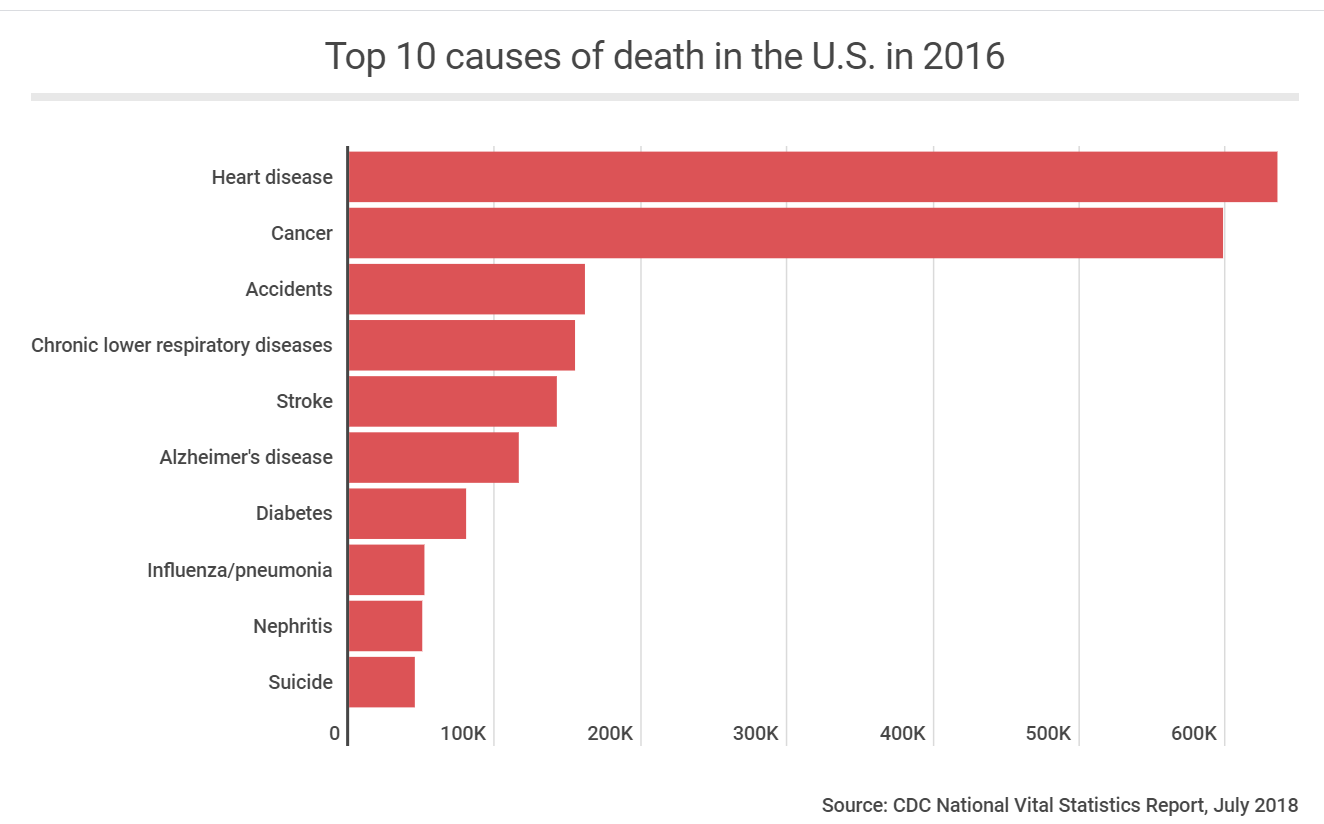
In 2018 and 2019 there were over 2,800,000 reported deaths in America. That means in a worst-case scenario of nearly 400,000 Coronavirus-related deaths, that would still be less than 14% of all deaths last year. In a typical year over 600,000 Americans die separately from Cancer and heart disease as the table below depicts. Therefore, in a truly worst-case scenario total Coronavirus-related deaths would still be lower than those other categories.

coronavirus2

If we look at the evidence objectively we never shut down the economy and society because over 600,000 Americans died from heart disease, or from Cancer. Even after aggregating all those deaths we’ve seen that with over 2,800,000 combined deaths that was still not enough to shut down the economy. However, in an absolute worst-case scenario of 400,000 Coronavirus-related deaths we deemed it necessary to shut-down the economy without fully understanding the effects or consequences of that decision.

In the end, the social and economic costs associated with the extreme economic shut down are manifold, and include:

  • Millions of business closings (many of them will be permanent closures).
  • Tens of millions of job losses (more acute among the less skilled workforce which will push them into long-term poverty).
  • Trillions of dollars of lost retirement savings which will negatively impact many retirees.
  • Potentially hundreds of thousands impacted by mental health challenges (among them depression, anxiety and stress).
  • Major disruption to the education of our children and their preparation for life (including diminished job prospects in the near term).
  • A substantial jump in the National Debt in the order of Trillions of dollars which future generations will be asked to repay (with an increased likelihood that some of that Debt will never be repaid).
  • Continued ‘easy-money’ brought on by the Federal Reserve’s loose monetary policy which will continue to foster ‘moral hazard’ type decisions (to be addressed another time).
  • Decreased confidence in our public officials who we implicitly trust to make the best decisions for society given their access to critical information and resources.
  • Finally, the opportunity cost of the higher National Debt levels (currently sitting at over Twenty Four Trillion dollars, If you prefer 24,400,000,000,000) which will cause us in ten, or twenty or thirty years to cut back on major social spending like health care which will then cost millions more lost lives in the future.

In effect by making the decision that we did we’re saying collectively that saving the extra lives that we did in 2020 (let’s say realistically that’s an extra 100,000 lives that were saved) is more important than the millions of lost businesses and economic livelihood; tens of millions of lost jobs; Trillions of dollars in lost retirement savings; hundreds of thousands of individuals impacted by mental health concerns in the months and years ahead; and just as importantly millions more Americans who will undoubtedly die in the future because of our weakened economic state brought about by higher levels of indebtedness. We’re even implicitly saying that those extra lives saved are more important than the 600,000 Cancer and heart disease lives that are lost each year since we never devoted anywhere need the same level of resources to saving those individuals as we did with trying to save these Coronavirus lives.

Every life is equally precious whether they died from the COVID-19 Coronavirus, or Heart disease, or Cancer, or something else. They’re also equally important whether they died in 2020, or 2030 or 2040. It is clearly understood that the reason for the economic and societal shutdown was because the CDC provided such dire estimates on the possible numbers of deaths. Unfortunately, the CDC has a clear history of stoking fear and paranoia among Americans by significantly overestimating the worst-case scenario of the number of deaths. We saw that with the Swine flu estimates in 2009 when they stated that “hundreds of thousands of Americans could die”. Therefore they should not be relied upon to decide critical economic activities within our society.

We entrust our civil servants and political leaders with the awesome responsibility of making the best decisions for our collective benefits. Those decisions should never be made to benefit only the few, nor taken with the best interests of just the few in mind but should be taken after weighing all of the costs and all of the benefits of all segments of society.

Instead of the wholesale closure of many non-essential businesses and schools in early March what then should our decision-makers have done? Consider the cases of Taiwan, South Korea, Germany and even Switzerland. Those countries conducted aggressive testing and isolated only the identified cases and the people with whom they came into contact. They also ensured that proper masks and other relevant equipment were widely available to the rest of society well before this outbreak became an international pandemic, something our decision-makers could also have prioritized. In addition, our decision-makers could have addressed one of the epicenters of the outbreak, namely nursing homes. Those facilities proved to be a breeding ground for the virus hence should have been identified early and isolated, along with everyone who is 65 years or older. Students – who’ve proven to be very resilient, with a very low mortality rate – should have been allowed to stay in schools, with proper allowance given to the elderly teachers and other school workers, and those children with pre-existing breathing conditions. If we can subsequently require all students to study from home then we should have been prepared to isolate only the vulnerable ones and then make adequate provisions for their learning at home. In any advanced society the needs of the many should never be subjugated because of our concern for the few. That’s not progress, instead it’s backward thinking.

Our society and economy should never have experienced the wholesale shut down that we saw in March. Nevertheless, it happened. Now it’s time for our politicians and policy-makers to do the sound economic thing and reopen the economy as soon as possible before the damage becomes too difficult to repair, both in terms of economic loss and society’s mental health.


Keith Thompson is a former Senior Economist with an agency within the U.S. Department of the Treasury, and a former adjunct Economics professor with Ramapo College of New Jersey. He currently works as an international tax professional for one of America’s largest corporations.
The unintended consequences of Trump’s trade policies

07 Saturday Apr 2018

Posted by Keith Thompson in International Trade, National Debt

≈ 6 Comments

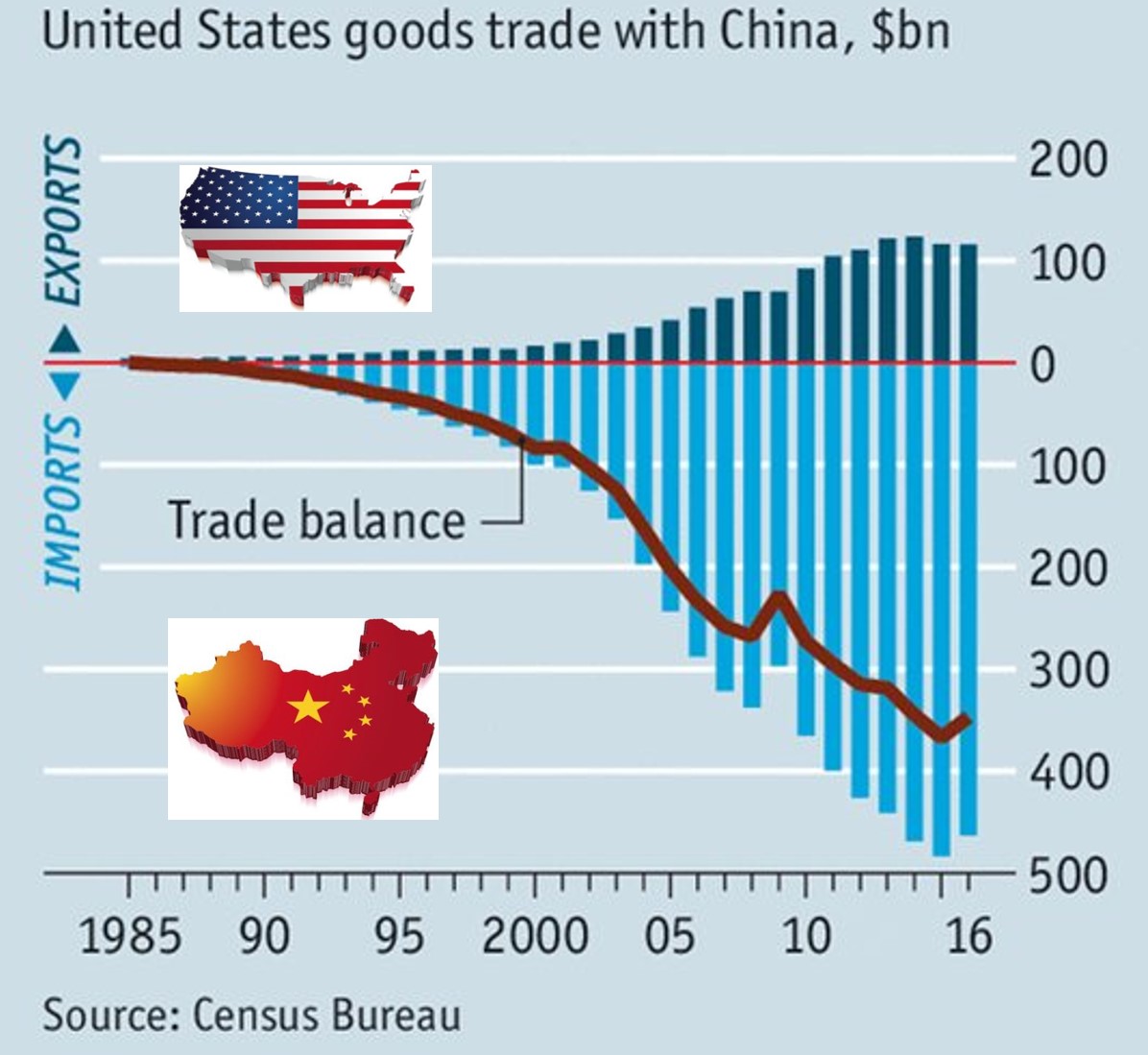
The monthly U.S. trade deficit rose to a nearly 10-year high in February 2018 to $57.6 billion. That was the highest level since October 2008 meaning that the trade deficit has now risen for six straight months. Of important political note the trade deficit with China fell some 18.6 percent to $29.3 billion while the deficit with Mexico surged over 46 percent.US_china_trade

These monthly numbers underscore a more alarming trend, that the U.S. trade deficit in goods and services has been poor for a number of years, and has in fact worsened over the past few years. The trade deficit grew 12% last year to a mammoth $566 billion, its widest mark since 2008. According to the Commerce Department the goods deficit with China rose 8% to a record $375 billion in 2017. That is nearly half the total goods trade deficit (the U.S. interestingly operates a surplus on the service side of the trade ledger). In response to these disturbing trade trends President Trump recently targeted 25 percent tariffs on over 1,000 Chinese products. These tariffs are in addition to ones already imposed on imported solar panels, large washing machines, and import duties on steel (25 percent) and aluminum (10 percent).

Needless to say we would expect an immediate retaliation from China. In this case they did by imposing similar duties on key American exports to them, namely on soybeans, airplanes, cars, beef and chemicals. However, is this expected to be the totality of China’s response or can we expect changes in other areas of their operations.

The power of economic analysis is its ability to predict, or at the very least anticipate, likely behavior my economic agents in response to external stimuli (like a foreign power imposing trade restrictions on them). So what is China likely to do, and how could this impact the U.S. economy?

At $2.3 trillion China is the world’s largest exporter of tangible goods, representing over 17% of their entire economy. Like the Asian Tigers before them this export-led strategy has been the key to China’s economic development, and growth into a global superpower. No doubt China cannot afford to alienate their largest market here in the U.S. and so we can expect them to make some concessions to the Trump administration in order to protect those beneficial trade numbers. In that regard there is likely to be a short-term victory for President Trump as the Chinese deficit with the U.S. will decline.

Unfortunately, economics also teaches us about the ‘Law of Unintended Consequences’. This means that things that were not expected nor even desired are also likely to manifest themselves in response to certain economic decisions. Here the Trump administration’s trade policy could not only temporarily reduce the trade deficit with China, but also increase consumer prices and even more importantly from a national security standpoint accelerate China’s rise into economic and global prominence. This presidential directive will force China to now speed up the industrialization of their agrarian sector, thereby growing the size of their domestic market. Currently everyone of the large developed economies around the world grew by expanding their domestic markets. This led to new jobs being created, and increased consumer spending power which resulted in the growth of established industries, and the emergence of new ones. China has been slow to adopt this policy because of the sheer size of their population and the large subsistence sector therein. These new proposed tariffs could however accelerate China’s plans towards domestic market expansion.

When this policy shift occurs China will become less dependent on global trade, consequently less likely to be influenced by U.S. foreign policy. It will also make China a growing national security threat in the decades ahead. Its important to note that China already has significant leverage over U.S. policy-makers on economic matters. They own over $1.2 trillion worth of our federal debt. Should they desire they could do any number of things which could cripple or at least disrupt the U.S. economy. They could reduce their purchase of such debt, instead shifting their purchase to other regions of the globe, hence spreading their global influence. They could also sell some of their significant holdings of U.S. bonds. These strategies will drive up U.S. interest rates across the board. It could also lead to the U.S. not being able to fully fund their annual budget which it has been increasingly funding by using deficit financing. No area of the economy will be spared of those negative impacts.

China may not be ready to employ those ‘nuclear-style’ bond sale strategies, or significantly retaliate against the U.S. by increasing tariffs across the board for fear of how that could destabilize their own economy in the short term, however once they fully develop their domestic market then they may be more likely to challenge the U.S. hegemony across the globe. These tariff policies may win the battle over reducing the short-term trade deficit with China but they will almost certainly in the long-term cause the U.S. to lose out to China on global dominance as China uses the opportunity to develop internally.


Keith Thompson is a Senior Economist in Transfer Pricing with an agency within the U.S. Department of the Treasury, and an adjunct Economics professor with Ramapo College of New Jersey.

America’s Youth: The Real Losers in 2016

31 Saturday Dec 2016

Posted by Keith Thompson in Federal Spending, Fiscal Deficit, National Debt

≈ 3 Comments

As we close out the year 2016 it is an opportune time to reflect on the state of the American Union and the pathway forward for sustained growth. After one of the most contentious presidential elections in modern political history America is once again juxtaposed in that delicate nexus between hope and disillusionment. Hope resonates amongst the supporters of President-elect Trump who see optimism in the country’s future, whereas despair looms large over the supporters of Hillary Rodham Clinton who worry about an America very different from the one they envision. Yet all Americans, Democrats and Republicans alike, should show some measure of concern for our youth who were largely left out of the electioneering discourse about the country’s future.

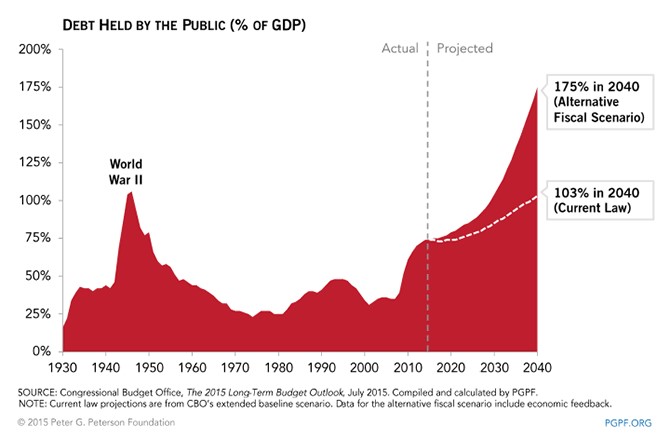
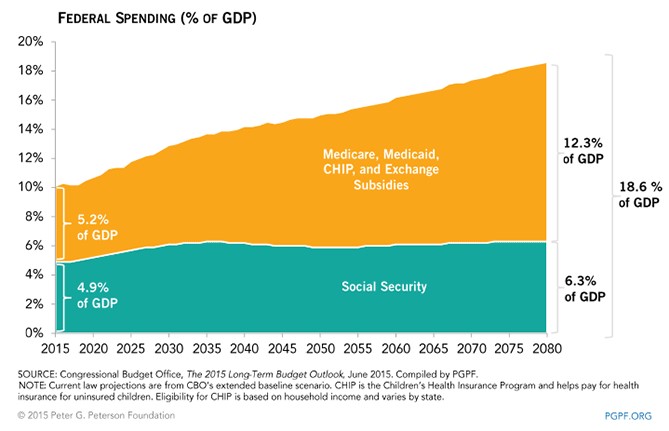
2015_cbo_longterm_chart1v2Let’s consider that the country’s largest economic constraints – the overburdened National Debt, soaring Social Security costs, and out-of-control Medicare obligations – represent the Federal government’s largest fiscal outlays. We are at a period in our history where Debt to GDP (including intra-agency Debt) is now over 100%, Social Security expenditures are running at nearly $900 Billion last year (23% of the Budget), and net Medicare/Medicaid obligations are currently at over $580 Billion in 2016 (15% of the Budget). What’s more troubling, however, is the trend in these numbers. The Peterson Foundation, with data from the non-partisan Congressional Budget Office (CBO), estimates that under existing law each will grow exponentially over the next 20+ years. Yet despite that impending fiscal crisis precious little was discussed about either long-term obligation on the campaign trails. Who does America think will be left to clean up the financial mess from these out-of-control spending, our youth. That would be the many of us currently in middle age, our young children and our (eventual) grand-children.
2015_cbo_longterm_chart5v2

Now that the semester is over I have time to reflect on the happenings in my College economics classes. At the end of a recent class a student came up to me to discuss the state of the economy. “Why” he asked “does our government make decisions where the costs of those decisions do not fall on the same group of people who receive the benefits.” That was a hard one to answer, I responded. After all politicians seem to be incentivized to make decisions with short-term benefits (so that they can effectively stay in power) hence it is rational for them to implement policies that benefit population groups with the highest voting rates (and that coincidentally does not belong to Millennials who had just a 50% voter turnout in the recent election). Conversely, tough decisions that have primarily long-term benefits tend to be postponed (or in Washington speak they “kick the can down the road”). That is the current state of our National Debt, Social Security, and Medicare obligations. The consequence of these decisions is that the living standards and income of our youth will significantly decline in the years ahead as the Peterson Foundation chart below shows.

2015_cbo_longterm_chart2v2

It is time that our politicians start actively thinking about the next generation when they craft policies. America can’t keep spending just to please the current generation of retirees with little regard for the well-being of our youth. After all it is America’s youth who will have to pay for these obligations in the years to come in the form of higher taxes, reduced benefits & services and lower real incomes.

President-elect Trump’s new administration and Congress need to put a plan in place to deal with these impending calamities, specifically:

  • Limit the Debt to GDP ratio to no more than 100%, with a plan to pay it down annually.
  • Limit the Overall Spending to GDP ratio to no more than 20%.
  • Limit the Budget Deficit to GDP ratio to no more than 1%.
  • Finally, both groups need to institute a super-majority requirement in both houses of Congress that must be met before these ratios can be breached (and only in cases of National emergencies).

The longer-term policy goal should be to get America’s fiscal house in order by generating Budget Surpluses and using them to pay down the Debt. If we don’t act now our youth will inherit an economy that looks a lot closer to a Third World economy, than the Advanced Industrial power that it truly is.


Keith Thompson is a Senior Economist in Transfer Pricing with an agency within the U.S. Department of the Treasury, and an adjunct Economics professor with Ramapo College of New Jersey.

Inequality and Economic Growth: The Case of America

01 Thursday Sep 2016

Posted by Keith Thompson in Black Economics

≈ Leave a comment

The issue of Economic Inequality (especially with respect to poverty) has never been a main focus of traditional economic theory or policy-making. Somehow that issue never fit neatly with the concepts of labor productivity, utility analysis or the IS-LM curve. Yet the concept of economic inequality is perhaps the most germane towards a deeper understanding of promoting Aggregate Demand and growth within an economy. As Keynesian economics explains increasing the income of the lower strata of society will increase overall Consumption and Aggregate Demand through a higher marginal propensity to consume among those strata, and the impact of the multiplier effect. Yet, despite the empirical confirmation of the validity of this theory as evidenced by post-war Europe’s rise in the 1950s and 60s the United States is still slow to embrace the policy of stimulating economic growth through reducing inequality.

If we break down the income numbers by racial lines we see that White-dominated households earned an average of $60,300 per year in 2014, compared with $35,400 for Blacks and $42,500 for Hispanics. That meant that Blacks earned less than 60% of the income that Whites earned in America, while Hispanics earned a shade over 70%. To put this into context, Black Americans comprise about 13% of the population but earn less than 9% of overall income. This has implications for many things beginning with a lower ability to afford quality housing, attend quality schools, promote healthy food choices, all the way to reducing their likelihood of saving for retirement. The ripple effect of this reduced income level therefore permeates through all segments of our society.

It also means that the incidence of poverty is highest in these racial and ethnic groups. In 2014 the poverty rate for non-Hispanic Whites was 10.1 percent, compared with 26.2 percent for Blacks and 23.6 percent for Hispanics.

Understandably, owing to the higher incidence of poverty and inequality among those racial groups their economic impact is smaller within our economy. However, finding ways to increase the incomes of Blacks and Hispanics will significantly stimulate Aggregate Demand and growth within our economy. For e.g. raising the household income of Blacks to match those of Hispanics in the U.S. will initially expand the economy by 1.7%. While that it a modest expansion, when the multiplier effect fully kicks in it should see the long-term growth trajectory of the economy increase measurably by over 5% per year. Likewise, if both racial groups see their incomes increase to three-quarter of that of Whites the short-term impact on the economy will be a 3% per year additional expansion with the long-term multiplier effect on the growth rate increasing by nearly 7% annually.  Those are gaudy numbers indeed and not ones to be scoffed at. Alleviating poverty and promoting economic equality may sound like virtuous policy aims but they may also provide a sound platform for long-term growth and development within the U.S. economy.

Keith Thompson is a Senior Economist in Transfer Pricing with an agency within the US Department of the Treasury, and an adjunct Economics professor with Ramapo College of New Jersey.

The third phase of Black America’s fight for racial equality

26 Tuesday Jul 2016

Posted by Keith Thompson in Black Economics, Black Lives, Blacks in America

≈ Leave a comment

It is perhaps the most beautiful piece of political prose ever written, rivaling one of Shakespeare’s sensational sonnets. Whilst the opening sentence is memorable for its own contextual significance, it is the second sentence – crafted on July 2nd, 1776 – that resonates throughout the fabric of humankind.

“We hold these truths to be self-evident, that all men are created equal, that they are endowed by their Creator with certain unalienable Rights, that among these are Life, Liberty and the pursuit of Happiness.” Source: United States Declaration of Independence. Formally adopted on July 4, 1776.

When Thomas Jefferson, with the help of Benjamin Franklin, crafted those immortal words the notion of all men only referred to ‘white’ men since after all a black enslaved man was only considered to be worth three-fifths of a white man. Ninety-two years later (after the 14th Amendment was ratified in 1868) blacks were placed on that same elevated pedestal and granted equal rights status with whites. Yet one hundred and forty-eight years after that ratification Blacks in America are still fighting to lay claims to more of those ‘unalienable Rights’ and testify to those ‘self-evident truths that they too are created equal’. But why has it taken so long, and where did it all go wrong for Blacks in America.

Black America is in her third phase of the fight for freedom. The first occurred during the period of enslavement. That battle was initially won on January 1, 1863 with President Lincoln’s Emancipation Proclamation. It signaled White America’s willingness to go to war to guarantee Blacks those ‘unalienable Rights’. That phase ended with the full abolition of slavery upon the ratification of the 13th Amendment on December 6, 1865.

However, while some political rights were won with that freedom fight the real battle for economic survival and social acceptance ensued. And like all forms of human oppression throughout the history of man, the subjugation of one form of oppression only leads to the rise of another. Post-slavery Black America had to fight against many Black Codes and Jim Crow laws and the then-prevailing legal doctrine of ‘separate but equal’. This implied (and in some cases was overtly stated) that whilst blacks may have been legally equal, they were to be socially and politically separated from White America. This second phase of the fight for freedom that was led by Dr. Martin Luther King, Jr. sought to achieve an end to de jure (or legal and overt) racial segregation, and promote equal access to social institutions such as hospitals, schools, hotels, restaurants, public transportation, and even the ballot boxes. By 1965 it was achieved via the enactment of the Civil Rights Act and the Voting Rights Act.

Since the Civil Rights Movement of the 1960s the form of racial oppression that many blacks now face has morphed into more de facto forms. It is the subtle forms of racism, economic deprivation, police brutality, attitudinal biases, unequal treatments under the law and within the courts. It is easy to fight racism when it manifests itself in overt forms equipped with shackles or official tags such as segregation or apartheid. However, when those labels are removed the struggle becomes harder for the public to embrace. This is the third phase, the battle for the hearts and minds of all whites (and some blacks too) to the ongoing fight for full and complete equality.

If the first phase of the struggle for racial equality could be categorized as a battle for freedom (Liberty) and the second a battle for equal access to social institutions (pursuit of Happiness) then the third phase of the struggle must deal with the fight against unjust killings and could surely be viewed as a battle for equal social, political and economic treatment (a battle for Life, or its worth).

America’s pursuit of the democratic ideal has been a long endearing struggle. Democracy remains under development in this country as it took black men ninety-four years after Thomas Jefferson’s pantheonic words to gain the constitutional right to vote (1870), and another ninety-five years after that for Congress to make it universal across the country (1965). It took white women one hundred and forty-four years before they won their constitutional right to vote (1920), and while African American women earned suffrage at the same time as their white counterparts it wasn’t until the Voting Rights Act of 1965 that their rights were fully enshrined. Finally, it took one hundred and ninety-two years for the first Americans – Native American Indians – to earn full civil rights (in 1968), despite earning citizenship in 1924. And despite these gains Native Americans still do not have universal voting rights throughout the country.

We the People are continuing to form a more perfect Union here in these United States of America. It hasn’t reached full perfection yet, but with each sub population receiving its own slice of those ‘unalienable Rights’, America will eventually define what true democracy looks like. Let us hope that at the conclusion of this third phase Black America will have been blessed with her full complement of inalienable Rights.

Keith Thompson is a Senior Economist in Transfer Pricing with an agency within the US Department of the Treasury, and an adjunct Economics professor with Ramapo College of New Jersey.

The two demands of the Black Lives Matter movement

20 Wednesday Jul 2016

Posted by Keith Thompson in Black Economics, Black Lives, Blacks in America

≈ 2 Comments

The horrific assassinations of 8 police officers over the past two weeks (5 in Dallas and 3 in Baton Rouge) have emphasized just how racially divided this country is becoming. Let’s be clear the targeted assassinations of police officers have no place in our society and must be unequivocally condemned. Despite the fact that the perpetrators were ex-military who may have had psychological problems what they did cannot be tolerated or justified.

Unfortunately, the climate that those murderers operated in cannot be ignored either. So venomous is the rhetoric and animosity on both sides it seems that neither side is truly listening to the other to hear what they are really saying. If they did they will realize that many proponents of the ‘Blue Lives Matter’ movement are justifiable fearful every time their fathers, mothers, husbands, wives, brothers, sisters, uncles go out to work. Police officers are our family members, friends and neighbors and like our brothers and sisters serving in the armed forces in foreign lands many of these police officers are waging legitimate war here at home against criminal elements. The risk is great that some of them will not return home and yet it appears many in our society don’t fully appreciate the work that they do.

Likewise, the Black Lives Movement is not arguing that all cops are bad, nor are they advocating violence against cops. Far from it, many members of the black community celebrate the presence of police officers within our neighborhoods, and applaud them for the outstanding work that they do. It is the police who protect many of these black communities from the scourge of drugs, gangs and other criminal behavior. It is the police who organize many of these local athletic leagues to keep our children out of trouble, and even volunteer coach in them. However, what seems to get lost in the message is the fact that some of those supporting the police officers seem to be tone deaf to the cries of the black community that their young African American brothers especially are being targeted at an alarming and unjustified rate. Yes, there are some undesirable criminal elements within the black community but many of the killings against African Americans are directed towards innocent men and women. In what universe would a civilized society tolerate that level of injustice to individuals who did no wrong. The cries for justice and respect from both sides are growing louder, yet not being heard.

I’m an African American man who has thankfully never had a negative encounter with the police. Yet it didn’t always feel that way. In the late 1990s I lived and worked in New York City (lived in the South Bronx, a few blocks from Yankee Stadium, and worked on Wall Street). While my interactions with the police were always courteous I frequently felt a sense of unease, especially when I worked late and was commuting back home.

Things hit a crescendo for me when my first son was born in late 1998 and so at the first opportunity (in January of 1999) I moved out of the South Bronx into a safer section in the northern part of the borough. That proved to be very prescient as exactly one month later on February 4, 1999 four police officers fired 41 shots at an unarmed young black man named Amadou Diallo, killing him instantly outside his South Bronx apartment. That brought things into sharp focus for me. At the time of his killing Amadou Diallo’s immigrant status was unknown to those cops. Neither were his educational levels, work accomplishments, nor community involvements. All that the four police officers knew was that he was a black man who they viewed with suspicion. I started to view myself in a similar light. It didn’t matter that I had multiple graduate degrees, or graduated from the most prestigious university in New York City. It didn’t matter that I worked as an economist or a financial analyst. That’s not what the police see when they first see me. They see me as black, and that means I’m a threat whether its real or imagined.

Immediately after 9/11 I moved my young family over to northern New Jersey because, among other things, I could not – in all good conscience – subject my son to living in a world where the city’s political leadership appeared to be fighting a war against blacks. The then mayor would defend the actions of his cops even when they were clearly in the wrong and that was intolerable for me. It shouldn’t matter what color you are, right and wrong should be absolute in certain areas, especially when it related to the sanctity of life.

Since living in New Jersey I’ve lived in predominantly white communities and while I’ve been stopped on a number of occasions, primarily for speeding – I’m now a reformed speedster – the contrast between policing in northern New Jersey to that which I experienced in New York City could not have been any starker. My interactions with the police in northern New Jersey were courteous and always professional on both sides. In fact, for the last eight years or so I’ve served as a volunteer coach for my sons’ local sports teams in my town and on many occasions I’ve been fortunate to work with local police volunteers. They were always gracious, diligent and a pleasure to work with. We’ve never had an issue, and I know that that’s true for many other communities as well. I just wonder why police officers everywhere cannot adopt the same attitude of servitude and respect, however, I’m not naïve to the realities in other communities.

Data from The Washington Post’s project on fatal police shootings showed that of the 1,502 people that have been shot and killed by on-duty police officers since Jan. 1, 2015 (including the recent killings of Alton Sterling in Baton Rouge, LA and Philando Castille in Falcon Heights, MN) some 381 were black (representing 24% of all Americans). Most troubling, exactly 50 of the slain victims were unarmed blacks, the same number as were white. However, given the fact that there are nearly 160 million more white people in America than there are blacks shows that unarmed black Americans are nearly five times as likely as unarmed white Americans to be shot and killed by a police officer.

As alarming as those killing statistics are equally disconcerting is the fact that only 10 of those cases where an unarmed black person was killed by the police resulted in the involved officer(s) being charged with a crime according to data from http://mappingpoliceviolence.org, and in only 2 of these instances (deaths of Matthew Ajibade in January of 2015 and Eric Harris in April of 2015) were the officers involved convicted.

Maybe the leadership shown by the civic and political leaders in the respective communities has a lot to do with the quality of policing we observe across the country. While the political leadership in New York City during the late 1990s may have perpetuated the divide between cops and the black community we have also seen positive leadership like the ones we observed in Dallas in the aftermath of those undeserved officers’ slayings, and in northern New Jersey where I live. It’s not a perfect harmony but the civic and political leadership are clearly committed to making it work.

Since January 2015 – according to The Washington Post’s data – Police have shot and killed 175 young black men (ages 18 to 29); 24 of them unarmed. This compares with 172 young white men shot and killed by the police over that same period, 18 of whom were unarmed. The data shows the gross disparity when adjusted for population, blacks – both armed and unarmed – are being killed at rates disproportionate to their percentage of the U.S. population. Of all of the unarmed people shot and killed by police in 2015, 40 percent of them were black men, even though black men make up just 6 percent of the nation’s population.

Despite arguments made by certain ill-advised segments of our society (spewing the same divisive rhetoric as they did during the late 1990s) most of those police killings are not the result of the increased violence within those black communities.

A recent article published by The Washington Post citing independent analysis of the same police shooting data and conducted by a team of criminal-justice researchers concluded that, when factoring in threat level, black Americans who are fatally shot by police are no more likely to be posing an imminent lethal threat to the officers at the moment they are killed than white Americans who were fatally shot by the police.

According to Justin Nix, a criminal-justice researcher at the University of Louisville and one of the report’s authors, “The only thing that was significant in predicting whether someone shot and killed by police was unarmed was whether or not they were black. Crime variables did not matter in terms of predicting whether the person killed was unarmed.”

“This just bolsters our [view] that there is some sort of implicit bias going on,” Nix added. “Officers are perceiving a greater threat when encountered by unarmed black citizens.”

Police officers in every community should be trained to properly assess threat levels and respond appropriately, not simply react to perceived threats with implicit acts of bias. It is unacceptable to kill someone just because one feels threatened by them without the victim having committed an overt act to justify that threat. Early in this country’s history the worth of blacks was constitutionally enshrined as being less than that of whites (click here to read more). However, with time we all hoped that those attitudes had changed. Unfortunately, the continued needless killings have caused many to question whether black lives have increased in worth over these past 240 years. The Black Lives Movement needs to see black lives valued more highly. What I believe the Black Lives Movement really wants is change on two critically important fronts.

First, we demand that the black members of society not be shot at first then asked questions of later. Properly assess the threat levels before shooting at us. Many blacks know that most police officers (maybe as much as 99% of all cops) are decent law-abiding citizens who conduct their jobs with dignity, decency and respect for all Americans. Those officers, unfortunately are being unfairly lumped in with the other unscrupulous elements who while they are few in number cause the bulk of the infractions and cast a bad eye on the entire police force. Maybe increased training can reduce the number of incidents of unnecessary killings, but we also need to see the cops involved in these unarmed shootings removed from the police force. If consequences do not follow actions, then bad behavior will not change and the good cops will unfortunately continue to be stigmatized with the bad ones.

Secondly, for change to be lasting the Black Lives movement needs to see those cops who exhibit fatally bad judgments – who many believe are in the minority – be punished. It cannot be that with so many unjust killings so few of the officers are prosecuted. America needs to purge herself of these few bad cops so that the many good ones can continue their jobs in relative peace and harmony. The future of the Republic lies in removing those few bad cops. Increasing the prosecution of bad behavior will undoubtedly reduce the number of unnecessary killings. If not, we are creating a form of Moral Hazard within our police communities.

Let us begin the process of racial healing by first removing those cops involved in these unarmed shootings from the police force. Some mistakes are worse than others, and for officers to get a promotion after killing an unarmed person is unconscionable such as what occurred in 2015 when Kenneth Boss – one of the officers involved in the Amadou Diallo killing – received a promotion to the rank of sergeant. Secondly, we cannot be throwing individuals in prison for simple crimes and not prosecute others for unjustly taking a life. Law and order requires that all of us in America be held to the same level of justice, otherwise justice is not blind. After 150 years of Emancipation from slavery it is time for Black Lives to matter too.

Keith Thompson is a Senior Economist in Transfer Pricing with an agency within the US Department of the Treasury, and an adjunct Economics professor with Ramapo College of New Jersey.

Three-fifths of a person: the economic value of blacks in America

08 Friday Jul 2016

Posted by Keith Thompson in Black Economics, Blacks in America

≈ 6 Comments

Many African Americans have long felt that they are not treated as equal to whites in this country, a view that no doubt has its genesis in the scourge of slavery and was further promulgated at the birth of the Union. Article I, Section 2, of the U.S. Constitution for eg. declared that an enslaved black would be counted as three-fifths of a white inhabitant of that state. That assertion was first proposed by James Wilson, Pennsylvania’s delegate to the Constitutional Convention in 1787 and a future Supreme Court Justice. While such a valuation was primarily used to determine State representation in Congress it nonetheless appeared to subconsciously associate a lower value for blacks than that of whites in our society that pervades even to this day.

As an economist I generally do not interject into matters of a highly emotive nature. After all economics is very objectively driven with rational responses to challenging issues, whereas issues of social justice tend to ignite emotions and inflame the passions. Nevertheless recent crises within our society have called into question the worrying question of the true worth or value of Blacks in America today, one that I would be loathe to ignore. By way of full disclosure I’m a valuation specialist. My expertise is in valuing what are termed ‘hard-to-value’ assets. I assess a value for intangible assets and intellectual property rights. I research values for non-traded technology and marketing assets that are transferred to related parties. I’ve also developed an expertise in evaluating athletic performance and related skill-sets. However, I’ve never attempted to value the economic worth of Blacks in America. That is a complex task. It requires a thorough understanding of the differentials in lifetime earnings potentials, promotion possibilities, barriers to entry into certain fields of endeavor, even access to institutions for career advancements. Clearly it is very challenging indeed.

Yet for all these challenges there is enough anecdotal evidence that Black lives are not worth as much as we as a society would like to believe. an analysis of FBI data from 2012 by Vox showed that police killing of blacks accounted for 31 percent of all killings in 2012, even though blacks made up just 13 percent of the U.S. population, a two-and-a-half times disparity. While this data may indeed reflect the fact that many of those killings were related to criminal behavior, and some may even be justified killings another chilling statistic is even more damning. Of those police killings that occurred when the victims were NOT attacking at the time when they got killed (read that victims like Michael Brown, Eric Garner, Freddy Gray, Alton Sterling and Philando Castille) the data suggests that 39 percent of them were black. That’s fully three times higher than the black population, a truly disproportionate number.

A review of selected killings of unarmed blacks at the hands of the police reveals the following:

Date Person Result Verdict
March 1991 Rodney King Beaten by 4 LA cops All 4 cops acquitted of State charges but 2 officers found guilty in federal court of violating King’s civil rights.
Feb 1999 Amadou Diallo Shot & killed by 4 NYC cops who fired 41 bullets at him Acquitted by Jury in Albany, NY.
July 2014 Eric Garner Choked to death by a NYC cop Grand jury decided not to indict the police officer.
August 2014 Michael Brown Shot to death by a Ferguson, MO policeman Grand jury decided not to indict the police officer.
April 2015 Freddie Gray Died at the hands of 6 Baltimore cops (depraved indifference) At present 3 of the 6 officers involved have been acquitted with 2 others yet to stand trial, and 1 expecting a retrial.
July 2016 Alton Sterling Shot to death by 2 Baton Rouge policemen To date no charges have been brought against the officers involved in the shooting
July 2016 Philando Castille Shot to death by a St. Anthony, MN policeman To date no charges have been brought against the officer involved in the shooting

The struggle for many blacks is that these killings for the most part continue to go unpunished which compounds the issue of the unjustified killings. The pain gets amplified within the black community.

Many African Americans had always felt that James Wilson’s valuation of Blacks in America was wrong. We all felt that Blacks were not worth three-fifths of a white. Alas what we did not realize was that judging by the acquittals after the ghastly killings James Wilson’s valuation may now prove to have been too high.

Keith Thompson is a Senior Economist in Transfer Pricing with an agency within the US Department of the Treasury, and an adjunct Economics professor with Ramapo College of New Jersey.

The U.S. Tax code: All things to all politicians

19 Tuesday Apr 2016

Posted by Keith Thompson in Tax Reform

≈ 2 Comments

As America welcomes the close of the 2015 tax filing season we are again embroiled in yet another combative discussion of just how best to reform the very cumbersome tax code. The current U.S. tax code has been used by many a politician to solve numerous social and public ills from poverty alleviation, to promoting housing, college participation and business investments. Along the way the disjointed nature of these individual programs have led to painful unintended consequences and a situation where, in aggregate, they may now be counterproductive.

Consider first the mortgage interest deduction. It was specifically carved out of the 1986 tax reform bill primarily to help promote home ownership. However, over the past 30 years it has done anything but. This deduction currently costs the Federal government some $70 Billion annually in lost revenues but ends up being principally utilized by holders of large mortgages, not first-time home buyers. In addition, it provides an unintended disincentive to renters who do not qualify for such tax benefits. That in turn forces many of those renters to accelerate home purchase before they are financially qualified to do so, further increasing the risk of foreclosures down the road. This deduction is widely viewed by many economists to not have the intended public policy benefits. In fact, to no one’s surprise, only the real estate industry supports keeping this deduction in the tax code.

Another deduction worth considering is the student loan interest deduction. The 1913 Revenue Act allowed deductions for all personal interest expenses (including student loan and credit card interest) before the 1986 tax reform bill eliminated those write-offs. In 1997 – after bowing to intense political pressures – the student loan interest deduction was reinstated. Continued economic and legal analysis since then have revealed absolutely no positive benefit to society as individuals do not make college decisions based on that deduction. Rather their decision to attend college is principally based on the expected benefit in the form of higher salaries and pursuit of career aspirations.

Other potential policy inefficiencies emanating from the tax code include using the Earned Income Tax Credit (EITC) to address poverty (but doing so using the number of children as the primary metric, rather than regional cost-of-living differentials); promoting tax rate differentials on capital gains and carried interest on the theory that they spurs investments when most of those gains emanate from secondary market transactions which tend to have a de minimis, or at best marginal, impact on business investments.

It is tempting for politicians who are stumping for political support to carve up the population into identifiable groups and target them with discreet policy prescriptions. However, rather than picking winning sectors the government would be better served eliminating all of these deductions and reducing the tax rates across the board. Then, if they’re interested in promoting individual sectors they can do so using non-tax sector-specific policies. Simplifying the tax code is good business for everyone as this will have the greatest stimulative impact on the economy.

Keith Thompson is a Senior Economist in Transfer Pricing with an agency within the US Department of the Treasury, and an adjunct Economics professor with Ramapo College of New Jersey.

Unfunded Mandates & off-Balance Sheet Liabilities: Notes of caution for America’s Policy makers to consider

25 Friday Mar 2016

Posted by Keith Thompson in Federal Spending, National Debt, Uncategorized

≈ 2 Comments

In 2001 Enron collapsed in what was then the largest corporate bankruptcy in U.S. history. Enron’s clever (read that questionable and unethical) accounting tactics used Special Purpose Entities such as FASITs, REMICs and REITs to hide significant and substantial financial liabilities from their Balance Sheet. The result was that investors, employees, clients and other stakeholders did not have an accurate picture of what the company owed, or what its risk exposure really was.

Fast forward now 15 years. There is another similar crisis brewing, except on a far grander scale. Recent reports suggest that the world’s largest market-based economies as represented by the Organization for Economic Cooperation and Development (OECD) have an estimated $45 Trillion in National Debts with the U.S. leading the way with over 40% of that total, or $19 Trillion. However, those figures neither paint a full nor a complete picture of the country’s true liabilities. Those debt figures show only liabilities as measured by borrowings. But what about obligations that are not on any of these governments’ Balance Sheets. Future obligations such as retirement-based liabilities like Social Security, or healthcare-related ones like Medicare & Medicaid are not included in the National Debt figures. Estimates out there suggest that when these future obligations are indeed included the U.S. really owes anywhere between $100 & $200 Trillion. That puts the real U.S. debt burden at over 500% of GDP, fully five times higher than current published data indicate.

Consider these facts. In the last published edition of the Financial Report of the U.S. Government, as of September 30, 2015 the United States had assets of just over $3 Trillion. In contrast, they owed over $21 Trillion, a deficiency of over $18 Trillion. This $21 Trillion in liabilities is comprised primarily of the Public Debt ($13 Trillion), Federal Employee & Veterans Benefits owed (nearly $7 Trillion) and $1.5 Trillion in other obligations. Of interesting note is the fact that intragovernmental debt (of $5 Trillion) is not included in the $21 Trillion liability figure since it offsets from one agency of government to another. However, it is still owed and payable by the U.S. government which means it is included in the $19 Trillion National Debt figures. The second more ominous note is that nowhere in these Financial Reports do we see Social Security, Medicare & Medicaid obligations owed. This may be because these obligations are payable by the Social Security and Medicare Trust Funds respectively, and not owed by the Treasury Department. But that is just a technicality. The same way the government can show its obligations to Federal Employees & Veterans for the benefits they are due, is the same way the government can report its obligations to the rest of its citizens who are due benefits in the form of Social Security and Medicare.

It appears that the United States is employing similar creative Enron-style accounting tactics to hide the true obligations off its Balance Sheets. The rest of the OECD economies should do well to heed the lessons currently emanating from the U.S. The sooner all parties recognize the full extent of their obligations the sooner appropriate policies can be put in place to remedy them.

Keith Thompson is a Senior Economist in Transfer Pricing with an agency within the US Department of the Treasury, and an adjunct Economics professor with Ramapo College of New Jersey.

← Older posts

Subscribe

  • Entries (RSS)
  • Comments (RSS)

Archives

  • May 2020
  • April 2020
  • April 2018
  • December 2016
  • September 2016
  • July 2016
  • April 2016
  • March 2016
  • February 2016

Categories

  • Black Economics
  • Black Lives
  • Blacks in America
  • Coronavirus response
  • Federal Spending
  • Fiscal Deficit
  • International Trade
  • National Debt
  • Tax Reform
  • Uncategorized

Meta

  • Create account
  • Log in

Blog at WordPress.com.

Privacy & Cookies: This site uses cookies. By continuing to use this website, you agree to their use.
To find out more, including how to control cookies, see here: Cookie Policy
  • Subscribe Subscribed
    • KeithThompsonEconomist.com
    • Already have a WordPress.com account? Log in now.
    • KeithThompsonEconomist.com
    • Subscribe Subscribed
    • Sign up
    • Log in
    • Report this content
    • View site in Reader
    • Manage subscriptions
    • Collapse this bar
 

Loading Comments...