
In the two months since the U.S. economy was effectively shut down because of the COVID-19 Coronavirus pandemic it has brought into sharp focus the need for a basic understanding of economics. The country saw tough decisions around balancing competing interests, and nothing was more critical than the decision to stop the spread of the COVID-19 Coronavirus by shuttering many businesses and thereby costing numerous jobs. However, was shutting down the economy and society the right decision? Just how do we measure the value of each life saved through our social distancing actions? How do we compare that decision with the lives shattered by lost jobs, closed businesses, and destroyed retirement accounts?
As of the end of day April 18th there were approximately 39,000 estimated deaths from the virus and over 738,000 reported cases within the U.S. The table below shows just how these statistics compare with other recent pandemics and the seasonal flu.
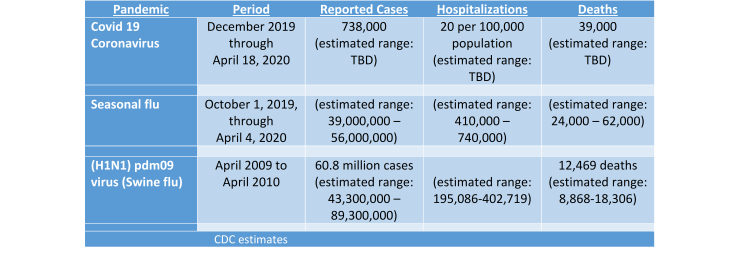
A July 2009 CDC report suggested that “hundreds of thousands of Americans could die over the next two years if the vaccine and other control measures for the H1N1 (Swine flu) influenza are not effective, and, at the pandemic’s peak, as much as 40% of the workforce could be affected,” according to new estimates from the Centers for Disease Control and Prevention. That was admittedly a worst-case scenario that the federal agency said it didn’t expect to occur. In the end the CDC’s final estimate was a death total of no more than 18,306, well short of the “hundreds of thousands” that they predicted.
In addition, each year an estimated 36,000 individuals die from the seasonal influenza virus. For this season – that runs from October 1, 2019 through the latest available data on April 4, 2020 – the CDC estimated that anywhere from 24,000 to 62,000 persons died, and somewhere between 410,000 and 740,000 were hospitalized owing to the seasonal influenza virus.
While it is true that the death rate (also called mortality rate) among those who contract the COVID-19 Coronavirus is significantly higher than those who are infected with the seasonal flu, or even those inflicted with the H1N1 (Swine flu) influenza, the total numbers of infected individuals is still relatively small compared with the overall population. Understandably many readers this will credit the smaller numbers of infections, hospitalizations and deaths resulting from the COVID-19 Coronavirus to the strict social distancing measures put in place. Others will say that the numbers in all three categories would have been much, much higher without these shut down measures. But did that still justify paralyzing our society and economy the way we have, and is the Cost-Benefit analysis worth it?
Many analysts have attempted to link the COVID-19 Coronavirus pandemic to the deadly ‘Spanish flu’ of 1918 which killed some 675,000 Americans and millions more across the globe. That pandemic was a similar strain to the H1N1 influenza that we saw in 2009 and 2010. So why did it kill so many in 1918, and less than 20,000 in 2010? Despite over 100 years of data and time to answer this question the answer is still not known with absolute certainty. What is known is that recent studies of available data from the time showed that the Spanish flu H1N1 influenza was no more aggressive than previous influenza strains. Instead, the researchers found that it was the aftermath of the disease and the response to it, like overcrowding in medical camps and hospitals, resulting in malnourishment and poor hygiene which promoted bacterial infection. This in turn killed most of the victims of the Spanish flu.
Since we will never really know what the true numbers of deaths would have been had these strict social distancing measures not been put in place the best we can do is conduct a hypothetical analysis. With better hospitals and bacterial control facilities there is no doubt that we would not experience the level of 675,000 deaths, even scaling up for population growth. So, let us assume that absent the wholesale shutting down of the economy the death levels would have been ten times higher than they are now, that means instead of 39,000 deaths it would have been closer to 390,000, let’s even round up to 400,000. Is that death level large enough to justify the stringent shut down measures?
In 2018 and 2019 there were over 2,800,000 reported deaths in America. That means in a worst-case scenario of nearly 400,000 Coronavirus-related deaths, that would still be less than 14% of all deaths last year. In a typical year over 600,000 Americans die separately from Cancer and heart disease as the table below depicts. Therefore, in a truly worst-case scenario total Coronavirus-related deaths would still be lower than those other categories.
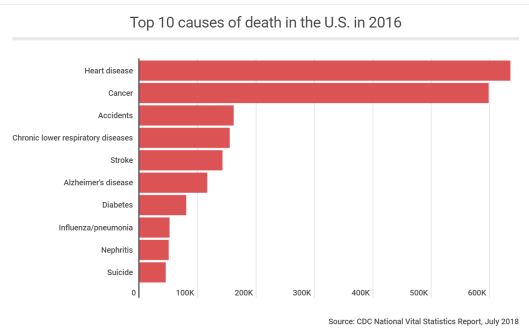
If we look at the evidence objectively we never shut down the economy and society because over 600,000 Americans died from heart disease, or from Cancer. Even after aggregating all those deaths we’ve seen that with over 2,800,000 combined deaths that was still not enough to shut down the economy. However, in an absolute worst-case scenario of 400,000 Coronavirus-related deaths we deemed it necessary to shut-down the economy without fully understanding the effects or consequences of that decision.
In the end, the social and economic costs associated with the extreme economic shut down are manifold, and include:
- Millions of business closings (many of them will be permanent closures).
- Tens of millions of job losses (more acute among the less skilled workforce which will push them into long-term poverty).
- Trillions of dollars of lost retirement savings which will negatively impact many retirees.
- Potentially hundreds of thousands impacted by mental health challenges (among them depression, anxiety and stress).
- Major disruption to the education of our children and their preparation for life (including diminished job prospects in the near term).
- A substantial jump in the National Debt in the order of Trillions of dollars which future generations will be asked to repay (with an increased likelihood that some of that Debt will never be repaid).
- Continued ‘easy-money’ brought on by the Federal Reserve’s loose monetary policy which will continue to foster ‘moral hazard’ type decisions (to be addressed another time).
- Decreased confidence in our public officials who we implicitly trust to make the best decisions for society given their access to critical information and resources.
- Finally, the opportunity cost of the higher National Debt levels (currently sitting at over Twenty Four Trillion dollars, If you prefer 24,400,000,000,000) which will cause us in ten, or twenty or thirty years to cut back on major social spending like health care which will then cost millions more lost lives in the future.
In effect by making the decision that we did we’re saying collectively that saving the extra lives that we did in 2020 (let’s say realistically that’s an extra 100,000 lives that were saved) is more important than the millions of lost businesses and economic livelihood; tens of millions of lost jobs; Trillions of dollars in lost retirement savings; hundreds of thousands of individuals impacted by mental health concerns in the months and years ahead; and just as importantly millions more Americans who will undoubtedly die in the future because of our weakened economic state brought about by higher levels of indebtedness. We’re even implicitly saying that those extra lives saved are more important than the 600,000 Cancer and heart disease lives that are lost each year since we never devoted anywhere need the same level of resources to saving those individuals as we did with trying to save these Coronavirus lives.
Every life is equally precious whether they died from the COVID-19 Coronavirus, or Heart disease, or Cancer, or something else. They’re also equally important whether they died in 2020, or 2030 or 2040. It is clearly understood that the reason for the economic and societal shutdown was because the CDC provided such dire estimates on the possible numbers of deaths. Unfortunately, the CDC has a clear history of stoking fear and paranoia among Americans by significantly overestimating the worst-case scenario of the number of deaths. We saw that with the Swine flu estimates in 2009 when they stated that “hundreds of thousands of Americans could die”. Therefore they should not be relied upon to decide critical economic activities within our society.
We entrust our civil servants and political leaders with the awesome responsibility of making the best decisions for our collective benefits. Those decisions should never be made to benefit only the few, nor taken with the best interests of just the few in mind but should be taken after weighing all of the costs and all of the benefits of all segments of society.
Instead of the wholesale closure of many non-essential businesses and schools in early March what then should our decision-makers have done? Consider the cases of Taiwan, South Korea, Germany and even Switzerland. Those countries conducted aggressive testing and isolated only the identified cases and the people with whom they came into contact. They also ensured that proper masks and other relevant equipment were widely available to the rest of society well before this outbreak became an international pandemic, something our decision-makers could also have prioritized. In addition, our decision-makers could have addressed one of the epicenters of the outbreak, namely nursing homes. Those facilities proved to be a breeding ground for the virus hence should have been identified early and isolated, along with everyone who is 65 years or older. Students – who’ve proven to be very resilient, with a very low mortality rate – should have been allowed to stay in schools, with proper allowance given to the elderly teachers and other school workers, and those children with pre-existing breathing conditions. If we can subsequently require all students to study from home then we should have been prepared to isolate only the vulnerable ones and then make adequate provisions for their learning at home. In any advanced society the needs of the many should never be subjugated because of our concern for the few. That’s not progress, instead it’s backward thinking.
Our society and economy should never have experienced the wholesale shut down that we saw in March. Nevertheless, it happened. Now it’s time for our politicians and policy-makers to do the sound economic thing and reopen the economy as soon as possible before the damage becomes too difficult to repair, both in terms of economic loss and society’s mental health.
Keith Thompson is a former Senior Economist with an agency within the U.S. Department of the Treasury, and a former adjunct Economics professor with Ramapo College of New Jersey. He currently works as an international tax professional for one of America’s largest corporations.
 KeithThompsonEconomist.com